
First Christmas With Your Partner's Family: An Easy Group Game to Break the Ice
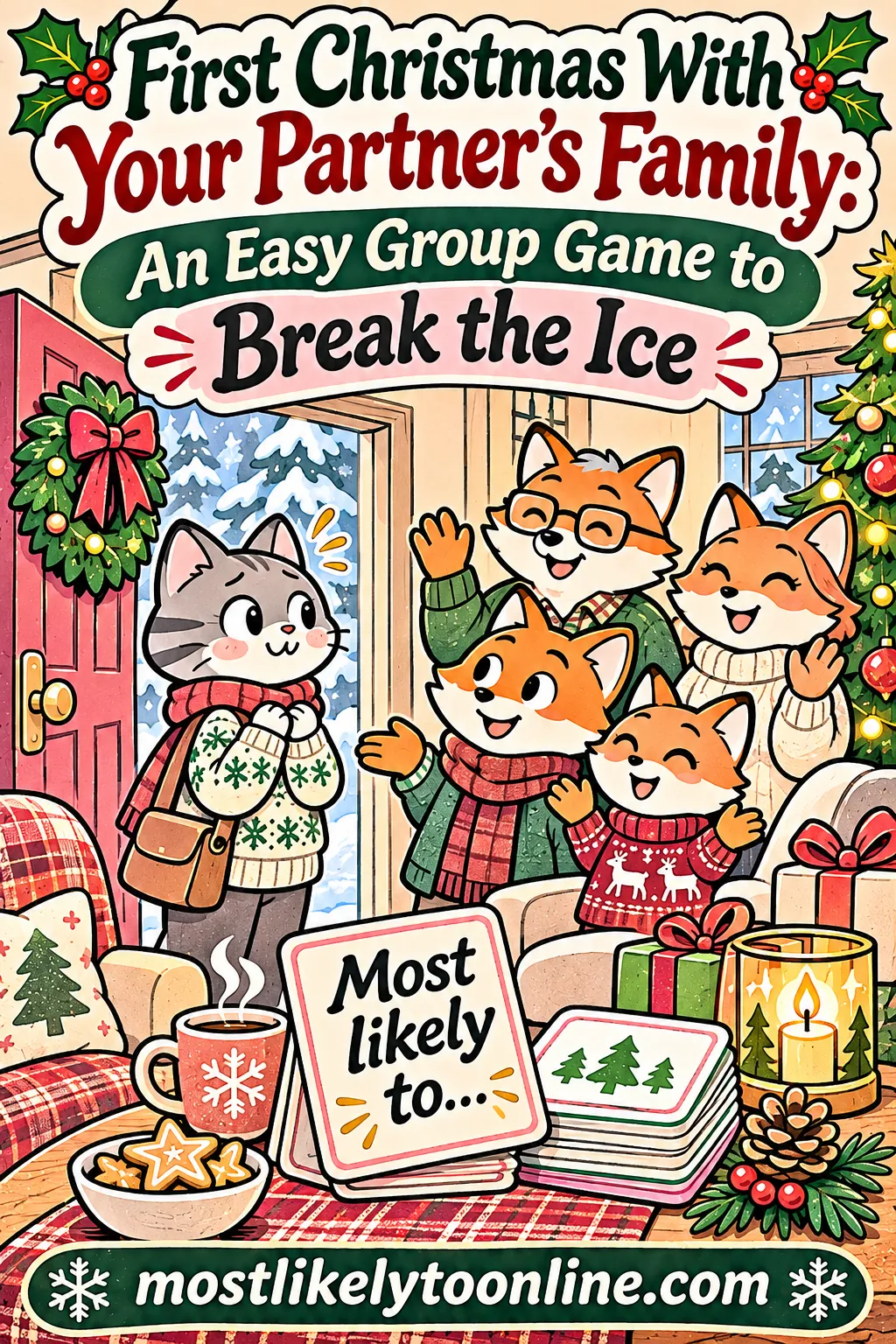
The easiest way to get through your first Christmas with your partner's family is to suggest a short, friendly group game where the relatives tease each other and you mostly get to listen, laugh and learn names, and a "Most Likely To" round does exactly that. Someone reads a prompt like "Who is most likely to fall asleep on the couch after dinner?", everyone points on three, and the family tells the stories behind the votes. You join in without being put on the spot.
You can run it from the free Most Likely To game on one phone, with no app and no sign-up. This guide covers how to pitch the idea without feeling pushy, the exact settings to use, newcomer-friendly prompts, scripts for awkward moments, and a simple plan for the whole day.
🎯 Play a round with this list
Read it out, then everyone points at who fits on the count of three.
Why Your First Christmas With Your Partner's Family Feels So Big
If your stomach is doing flips just thinking about it, that's normal. A first holiday with a partner's family stacks several stressful things into one day:
- A crowd of new names. You might meet ten or twenty people at once, and they all already know each other.
- Inside jokes everywhere. Every family has its own nicknames, stories and running bits. You walk into the middle of a conversation that started decades ago.
- Unwritten rules. When do gifts happen? Does everyone help clean? Is the good chair taken? Nobody tells you, because to them it's obvious.
- The wish to be liked. You care about your partner, so you care about what their family thinks of you.
- Long stretches of standing around. Between arriving, eating and opening gifts there's a lot of loose time, and loose time is where awkwardness lives.
That last one is the part a game fixes. The big moments, like dinner and gifts, have a built-in structure. It's the in-between hours that feel endless when you know almost nobody.
What a good icebreaker for this situation needs
Not every party game works when you're the new person. A good one for this day should:
- Put the spotlight on the family, not on you. You want them talking about each other while you soak it in.
- Need no supplies or setup. Asking a host to find dice and paper on Christmas is a big ask.
- Work across ages. Grandparents, teenage cousins and little kids should all be able to play.
- Stay friendly. No embarrassing secrets, nothing that could start a family argument.
- Be easy to stop. When the food comes out, the game should end without fuss.
- Teach you something. Names, relationships, the family's stories. That's the real prize.
Most Likely To fits that list well. Everyone points at once, so nobody has to answer alone. The prompts are about personalities and habits, which naturally pull out stories. And because the votes land on the family's own members, you get a crash course in who's who without asking a single awkward question.
Why a Pointing Game Works So Well for the New Person
Here's what happens in a typical round. Your partner reads, "Who is most likely to take over the kitchen?" Everyone counts to three and points. Eight fingers land on Aunt Linda. Aunt Linda throws up her hands and says, "Well, somebody has to make the gravy!" and three people jump in with the story of the year the gravy caught fire.
In those thirty seconds you learned that Aunt Linda is the cook, that she's proud of it, that there's a famous gravy story, and that this family loves to tease each other gently. You didn't have to say a word, and yet you were part of it, because you pointed too.
You get to play without performing
Icebreakers like "go around and share a fun fact about yourself" are hard for a newcomer. All eyes turn to you, and your fun fact has to land with a crowd you don't know. A pointing game flips that. Your part is a quick gesture made at the same moment as everyone else, so it never feels like a solo act.
You learn names in context
It's hard to remember twelve names from a round of introductions at the door. It's much easier to remember "Uncle Ray, the one everyone pointed at for getting lost on the way here." Every vote attaches a story to a face, and stories stick better than names alone.
The family gets to shine
Relatives love telling stories about each other, especially to someone who hasn't heard them yet. A game gives them a reason to dig out the classics. You become the perfect audience, and being a great audience is one of the fastest ways to be liked.
How to Suggest the Game Without Feeling Pushy
The idea of standing up in someone else's living room and announcing a game might sound terrifying. You don't have to. The smoothest approach is to let your partner pitch it, or to plant it casually with one or two people first.
Talk to your partner a few days before
Have a quick chat in the week before Christmas. Something like:
"I'm a little nervous about meeting everyone at once. Would it be weird if we brought a quick game for the afternoon? There's a free Most Likely To game on the phone. I thought you could run it so I don't have to be the one in the spotlight."
Most partners will say yes, because it takes pressure off them too. Ask them a few questions while you're at it:
- Who are the big personalities who'll love a game like this?
- Is there anyone who hates group games? (Good to know, so nobody gets pushed.)
- Are there any touchy topics to avoid, like a recent divorce, a job loss or a family feud?
- When is the slow part of the day, usually? After lunch? Before gifts?
Pick the right moment
Timing matters more than the pitch. The best windows are:
- After everyone has arrived but before the meal, when people are milling around with snacks.
- After dinner, when people are full, seated and in no hurry.
- While waiting for a late relative, when the group is already restless.
Avoid the first fifteen minutes after you arrive (everyone is still hugging hello), the middle of meal prep (the cooks are busy), and right before gifts (the kids won't wait).
Let a cousin or sibling help you launch it
If your partner has a sibling or cousin who's fun and outgoing, tell them about the game earlier in the day. When they say, "Oh, we should play that game you mentioned," it sounds like a family idea, not the newcomer's idea. That small shift makes it easy for others to join.
What to actually say
If you're the one pitching it, keep it light and low-stakes:
"Anyone want to play a quick game? It's called Most Likely To. Someone reads a question, like 'Who is most likely to fall asleep on the couch,' and on three everyone points at who they think it is. Takes ten minutes."
That last sentence matters. "Ten minutes" tells people it's a small commitment. Once a game is fun, nobody minds when it runs longer.
How to Set Up the Free Game for a Family Christmas Round
Set this up in the car or the night before so you're not fiddling with your phone in front of everyone. Open the Most Likely To game and go through these steps.
Step 1: Choose the Family or Christmas category
The categories sit along the top of the game. For a first visit, two work best:
- 👪 Family has wholesome prompts that work from grandparents to grade-schoolers. Start here if there are kids or older relatives in the room.
- 🎄 Christmas has holiday prompts about presents, decorations and Christmas morning habits. It's a natural fit once everyone is in the holiday mood.
Some families also enjoy the 🧑🤝🧑 Family Reunion pack if a lot of extended relatives are gathered. If a built-in prompt doesn't fit the room, just tap Next and move on. Whoever holds the phone decides what gets read aloud.
Step 2: Keep Content on Clean
Find the Content row and make sure Clean is selected. It's the default, and it filters the question bank down to family-friendly prompts. Bold adds livelier party prompts, which might be fine with your friends but is risky in front of your partner's grandmother. Leave it on Clean for the whole day.
Step 3: Leave the timer off
The Timer row offers off, 15s, 30s and 60s. Keep it off. A countdown makes a relaxed family game feel like a test, and older relatives may feel rushed. The reader sets the pace by counting "one, two, three" out loud.
Step 4: Think twice about Add players
The Add players switch lets you type in names, and then the game randomly assigns a player to each prompt, like "Grandpa Joe is most likely to fall asleep on the couch."
For a newcomer, this is a mixed bag. On the plus side, typing everyone's names forces you to learn them, and seeing the names pop up on screen helps them stick. On the downside, a random pick can land a teasing prompt on someone who doesn't love it, and pointing is where the real stories come from.
A good middle path: leave Add players off for the main game, but ask your partner to type in names before you arrive, just so you can study the list in the car. Turn it on only if the group can't agree on votes.
Step 5: Save the Vote button for later
With three or more players added, a 🗳️ Vote button appears. It runs a pass-the-phone secret ballot and keeps a scoreboard. It's fun, but it puts your phone in a dozen strangers' hands and slows things down. For a first visit, open pointing is warmer and faster. Save voting for a later Christmas, once you're part of the furniture.
Step 6: Add a few custom prompts (optional but powerful)
Tap ✏️ My Questions, type one prompt per line, and tap Save. Each line finishes the phrase "Most likely to…", so you'd type "tell the best story about the family," not the whole question. Your list becomes its own category, saved in that browser on that phone.
This is where you can quietly tailor the game. Ask your partner for three or four family facts, like "Grandma always hides a pickle ornament" or "Uncle Ray once drove to the wrong state," and turn them into prompts. When those come up, the room lights up, and people will wonder how you knew.
Step 7: Consider Big screen mode
If the family has a TV in the main room, 📺 Big screen shows the question card in large type. Everyone can read the prompt themselves, which helps older relatives and anyone hard of hearing in a noisy room. If the TV is busy with a game on, one phone read aloud is fine.
Step 8: Print cards if phones aren't welcome
Some families frown on phones during holidays. If that's your partner's family, tap 🖨️ Print cards, choose Cut-out cards, pick 12, 24 or 36 questions, and print before you go. The cards come from whichever category is selected, including My Questions. A small stack of cards in a holiday envelope looks thoughtful, almost like a little gift for the hosts.
Quick settings summary
| Setting | Choose | Why |
|---|---|---|
| Category | 👪 Family, 🎄 Christmas, or ✏️ My Questions | Wholesome and holiday-friendly |
| Content | Clean | Safe in front of every generation |
| Timer | Off | Keeps it relaxed, not a quiz |
| Add players | Off during play; use names to study beforehand | Pointing brings out the stories |
| Vote | Skip on a first visit | Keeps your phone in your hands |
| Big screen | On if a TV is free | Everyone reads along |
| Print cards | Cut-out cards, 24 | For phone-free families |
40 Icebreaker Prompts for Your First Christmas With the Family
These prompts are chosen for one reason: they get the family talking about each other in a warm way, while you learn who's who. None of them ask you to share anything personal, and none of them touch politics, money or old wounds.
Read them as written, or drop the "Who is" and paste the rest into My Questions.
Easy warm-ups (start here)
- Who is most likely to sneak a cookie before dinner?
- Who is most likely to fall asleep on the couch after the meal?
- Who is most likely to wear the loudest holiday sweater?
- Who is most likely to still be in pajamas at noon on Christmas Day?
- Who is most likely to shake every present to guess what's inside?
- Who is most likely to eat the last piece of pie?
- Who is most likely to wake up first on Christmas morning?
- Who is most likely to start a carol first?
Learn the family roles
These are gold for a newcomer. Every answer tells you who does what.
- Who is most likely to take over the kitchen?
- Who is most likely to remember everyone's birthday?
- Who is most likely to organize the family photo?
- Who is most likely to fix anything that breaks?
- Who is most likely to plan next year's get-together?
- Who is most likely to win every board game here?
- Who is most likely to give the most thoughtful gift?
- Who is most likely to keep the family group chat going?
Bring out the family stories
These pull out the stories you'll hear about for years.
- Who is most likely to tell the best story about the family?
- Who is most likely to know every ornament's backstory?
- Who is most likely to get lost driving to a relative's house?
- Who is most likely to have burned something on a holiday?
- Who is most likely to remember what everyone got last Christmas?
- Who is most likely to have the funniest childhood photo on the fridge?
- Who is most likely to tell an embarrassing story about my partner?
- Who is most likely to have broken a family tradition by accident?
Prompt 23 is your secret weapon. Families love telling a newcomer stories about the person they brought home. Let your partner read it, and enjoy the show.
Sweet and complimentary
- Who is most likely to cry at a holiday card?
- Who is most likely to give the best hugs?
- Who is most likely to make everyone laugh at dinner?
- Who is most likely to call just to check in?
- Who is most likely to drop everything to help someone?
- Who is most likely to make a newcomer feel at home?
- Who is most likely to save the wrapping paper to reuse?
- Who is most likely to remember how everyone takes their cocoa?
Lighthearted Christmas habits
- Who is most likely to put the tree up the day after Thanksgiving?
- Who is most likely to wrap gifts at the very last minute?
- Who is most likely to hide the best snacks for later?
- Who is most likely to still be playing games at midnight?
- Who is most likely to sing along to every carol on the radio?
- Who is most likely to string the lights perfectly straight?
- Who is most likely to buy a gift for the dog?
- Who is most likely to want to do this all again next year?
End with prompt 30 or 40. Both send a warm signal without you having to say anything mushy.
For more prompts that fit a mixed-generation crowd, see our Most Likely To questions for family and the Christmas edition of Most Likely To.
Prompts to skip on a first visit
Some prompts that are hilarious with friends can go sideways with a family you just met. Skip anything about:
- Money, jobs or who earns what. Touchy in most families.
- Past relationships. Especially about your partner.
- Weight, looks or age. Even as a joke.
- Who's the favorite child or grandchild. Old sibling tensions can flare up fast.
- Politics, religion or current events. Leave those off the table.
- Anything about who will get married or have kids next. That's a lot of pressure on you and your partner.
If one of these comes up from the built-in set, the reader just taps Next. Nobody will notice.
How to learn everyone's names (without asking twice)
The game is one of your best name-learning tools, but a little prep helps a lot.
Before the visit
Ask your partner to walk you through the guest list. Get names, how each person is related, and one fact about each. You might end up with a cheat sheet like this:
| Name | Relationship | One thing to remember |
|---|---|---|
| Linda | Partner's aunt, mom's sister | Makes the gravy, very proud of it |
| Ray | Linda's husband | Famous for getting lost |
| Grandma June | Partner's grandmother | Hides a pickle ornament every year |
| Tess | Cousin, about your age | Loves games, natural ally |
| Marcus | Partner's younger brother | Quiet, into cars |
| Ella and Finn | Tess's kids, ages 6 and 9 | Will want to play everything |
Keep it on your phone, but don't pull it out in the room. Study it in the car.
During the game
Every time a vote lands on someone, quietly connect the name to the story. "Linda, gravy. Ray, lost." Saying it in your head once is usually enough to make a name stick.
When it's your turn to comment, use names out loud: "I have to agree with everyone. Ray, how lost are we talking?" Using a name once in conversation helps lock it in, and people like hearing their own names from a newcomer.
Scripts for the Moments You're Dreading
A few prepared lines make the whole day feel less like improv.
When your partner kicks off the game
"Okay, everybody, quick game while we wait. It's called Most Likely To. I read a question, you count to three in your head, and then everyone points at who fits best. No points, no losers. First one: who is most likely to sneak a cookie before dinner? One, two, three, point!"
Start with an easy, silly prompt where the answer is obvious. An early laugh tells the room this game is safe and fun.
When the vote lands on you
It will happen, especially on prompts like "most likely to be nervous right now." Have a light line ready:
"Fair. Completely fair. In my defense, there are a lot of you."
Or, if it's a nicer prompt:
"I'll take it. Though I think you're all being very generous to the new person."
A short, self-aware joke is the goal. Don't over-explain, and toss the spotlight back with "Next one!"
When a prompt hits a sore spot
Sometimes a harmless-looking prompt lands on someone who goes quiet, or a family member makes a pointed comment. Your partner can smooth it over:
"Ooh, let's skip that one. Next! Who is most likely to give the best hugs?"
A kind, easy prompt right after a bumpy one resets the room. You don't need to know what the sore spot was.
When nobody wants to play
If the room isn't into it, let it go gracefully:
"No worries, we'll save it for after dinner."
Then actually drop it. Sometimes people warm up later and ask for the game themselves. Our guide to Most Likely To as an icebreaker has more tips on reading a room, and the wholesome edition is full of prompts that stay safely kind.
Ending the game
"Last one! Who is most likely to want to do this all again next year?"
Whatever the answer, it ends on a warm, forward-looking note. If you get any fingers, smile and say, "I'd love that." It's a simple, genuine moment, and families remember it.
A Simple Plan for Your First Christmas Day With Them
Every family runs Christmas differently, so treat this as a sample. The point is to see where a game fits in the flow of the day. Times assume a midday arrival and an early evening meal.
| Time | What's happening | What you can do |
|---|---|---|
| 11:30 | Arrive, hugs and introductions | Smile, say names back, offer to carry things in |
| 11:45 | Coats off, snacks out | Ask the host how you can help |
| 12:30 | Loose mingling | Find the cousin or sibling who's your natural ally |
| 1:00 | First lull | Partner suggests the game, 10 to 15 minutes |
| 1:20 | Back to mingling | Use the stories you just heard as conversation starters |
| 2:30 | Helping in the kitchen | Volunteer for a small, clear task like setting the table |
| 4:00 | Dinner | Listen more than you talk; compliment the cook by name |
| 5:00 | After dinner, everyone slows down | Second round of the game if the group asked for more |
| 6:00 | Gifts or dessert | Watch for family traditions; follow their lead |
| 7:00 | Cleanup | Offer to dry dishes; good chats happen at the sink |
| 7:30 | Goodbyes | Thank the hosts by name and mention one thing you enjoyed |
Variations for Different Kinds of Families
No two families are alike. Adjust the game to fit the room you walk into.
Big, loud families
If there are twenty people talking over each other, the game helps by giving everyone one thing to focus on. Use 📺 Big screen on the TV so people in the back can read along, and let a loud cousin be the reader. Keep rounds fast. You can also split into two groups, one in the living room and one in the kitchen. Our guide to best games for big groups has more ideas for a packed house.
Small, quiet families
With five or six people, the game feels more like a conversation. Slow down, let each vote turn into a story, and only play 8 to 10 prompts. Choose more of the "sweet and complimentary" prompts. Quiet families often warm up beautifully when the questions are kind.
Families with young kids
Kids love this game and make excellent allies. If there are children around, the Family or Kids category works well, and kids often volunteer to be the reader. Letting a 9-year-old run the game takes all the attention off you, and the parents will appreciate that you included their kids.
Families with older relatives
Grandparents may not be used to phone games. Big screen helps, and so do printed cards they can hold. Ask a grandparent to read a card aloud. It gives them a fun role and often leads to a story from decades ago.
Families who aren't "game people"
Some families just don't do group games. Don't force it. You can still use the prompts as casual conversation starters. At dinner, you might say to the person next to you, "Okay, I have to know, who's most likely to wake up first on Christmas morning in this house?" It works just as well one-on-one.
Troubleshooting: What If Things Get Awkward?
Even a friendly game can hit a bump. Here's how to handle the common ones.
| Problem | What's going on | What to do |
|---|---|---|
| Nobody answers the first prompt | People are unsure the game is for real | The reader points first and laughs; others follow |
| The same relative gets every vote | They're the family's big personality | Pick prompts that fit someone else, or turn on Add players for a round |
| A teasing prompt lands badly | A sore spot you didn't know about | Skip it, then read a kind prompt right away |
| A side argument starts | Old tension sneaking in | Partner says "Next one!" and reads something silly |
| Kids grab the phone | They want to be the reader | Let them read, with a grown-up nearby |
| You feel left out of the jokes | Inside jokes fly past you | Ask, "Okay, what's the story there?" Families love explaining |
| Someone seems annoyed by the game | Not everyone likes games | Let them sit it out; never push |
| The game runs too long | It's going well | Stop while people are still laughing |
When you just need a breather
Meeting a whole family is tiring, even when it goes well. It's fine to step outside for a few minutes, help with dishes for some quiet, or sit with the kids for a while. Agree on a small signal with your partner beforehand, like a squeeze of the hand, that means "I need five minutes." They can cover for you without anyone noticing.
If holidays bring real anxiety for you, not just everyday nerves, it can help to talk to a doctor or counselor. This guide is about a fun family game, not medical advice.
Small things that make a big impression
The game opens the door, but a few everyday habits keep it open.
- Bring something small. A box of cookies, a plant or a homemade treat for the hosts is a kind gesture. Ask your partner what fits.
- Offer to help, then actually help. "Can I set the table?" is easier to say yes to than "Do you need anything?"
- Ask follow-up questions. The stories from the game give you a whole list of them.
- Compliment specific things. "This stuffing is amazing, Linda" beats "Everything's great."
- Thank the hosts before you leave, and mention one moment you enjoyed. "The gravy story was the best part of my day."
Your quick checklist
Here's the short version to look at in the car:
- Talk to your partner about the game and the guest list a few days before.
- Learn names and one fact per person.
- Open the free Most Likely To game and pick 👪 Family or 🎄 Christmas.
- Keep Content on Clean and the timer off.
- Add three or four family-specific prompts in ✏️ My Questions.
- Print 24 cut-out cards if the family is phone-shy.
- Let your partner or an outgoing cousin launch the game during the first lull.
- Start with "sneak a cookie before dinner" and end with "want to do this all again next year."
- Use the stories you hear as conversation starters for the rest of the day.
Then take a breath. You're going to be fine. When the next holiday rolls around, you might be the one reading the prompts for the next newcomer, and the game will be ready when you are.
Frequently Asked Questions
How do I survive my first Christmas with my partner's family?
Prepare a little and lean on structure. Learn names and a fact about each person beforehand, agree on a break signal with your partner, offer to help with clear tasks, and suggest a short group game during the slow part of the day. A game gives everyone something to do together, which takes the pressure off small talk.
What's a good icebreaker game for meeting in-laws?
Most Likely To works well because everyone points at once, so nobody has to perform alone. The prompts focus on the family's habits and personalities, which brings out their stories while you listen and learn. It needs no supplies and works from one phone.
Should I be the one to suggest the game?
It's usually smoother if your partner or an outgoing sibling or cousin suggests it. That way it feels like a family idea rather than the newcomer's project. If you do suggest it, keep it casual and say it only takes ten minutes.
What prompts should I avoid with a new family?
Skip anything about money, past relationships, looks, age, politics, religion or who's the favorite. Also skip questions about who will marry or have kids next. Stick to light habits, holiday traditions and kind compliments.
What if the family isn't into games?
Don't push it. You can still use the prompts as casual conversation starters, one-on-one, at dinner or in the kitchen. Asking "Who's most likely to wake up first on Christmas morning here?" works as a friendly question even without a game.
How long should the game last?
About 10 to 15 minutes, or 15 to 25 prompts, is plenty for a first round. If the family asks for more, play a shorter second round after dinner. Stopping while people are still laughing leaves the best impression.
Is the game appropriate for kids and grandparents?
Yes. The Content level starts on Clean, which filters the questions to family-friendly prompts. The Family category works from grandparents to grade-schoolers, and Big screen mode or printed cards help anyone who'd rather not squint at a phone.
Can I add questions about my partner's family?
Yes. Open My Questions, type one prompt per line, and tap Save. Ask your partner for a few family stories ahead of time and turn them into prompts. They tend to get the biggest laughs of the day.
How do I remember everyone's names?
Get a quick list from your partner before the visit with one fact per person. During the game, connect each name to the story behind the vote, and use names out loud once when you comment. If you forget one, ask a cousin quietly; nobody minds.