Best Truth or Dare Alternatives for Any Group
The best Truth or Dare alternatives are games that keep the laughs and the "no way, that's so YOU" moments without forcing anyone to do something they'll regret. The easiest one to start right now is Most Likely To, where you add your friends' names and the game picks who's most likely to do each funny thing. It needs zero props, works for any age, and never puts a shy person on the spot the way a dare can.
Want to skip the reading and just play? Open the free Most Likely To game, type in everyone's names, and you'll be laughing within ten seconds. No app, no sign-up, no setup.

Why Look for a Truth or Dare Alternative?
Truth or Dare is a classic, and there's a reason it's lasted generations. But it isn't the right fit for every crowd. Sometimes you want the same fun energy without the awkward parts.
Here's why people go looking for something else:
- Dares can get uncomfortable. Not everyone wants to do a cartwheel in public or prank-call a relative.
- Truths can get too personal. A question that's funny for one group can land badly for another.
- It needs a brave crowd. Shy folks tend to sit out, which leaves the same two people doing everything.
- It can stall. When nobody wants the dare, the game loses steam fast.
The good news: there are plenty of party games that deliver the same "I can't believe you" laughs while staying inclusive and low-pressure. Let's run through the best ones.
The Best Truth or Dare Alternatives at a Glance
Here's a quick comparison so you can pick the right game for your group in a few seconds. After the table, we dig into each one.
| Game | Best for | Setup needed | Group size | Vibe |
|---|---|---|---|---|
| Most Likely To | Any group, all ages | None (free online) | 3–30+ | Funny, light, inclusive |
| Would You Rather | Quick debates | None | 2–20 | Silly to deep |
| Never Have I Ever | Sharing stories | None | 4–20 | Confession-style |
| Two Truths and a Lie | Getting to know people | None | 3–15 | Guessing game |
| Charades | Active groups | None | 4–20 | High energy |
| The Question Game | Deep convos | None | 2–10 | Thoughtful |
| Hot Seat | Bold groups | None | 4–12 | Personal, fast |
| Categories | Fast thinkers | None | 3–15 | Quick rounds |
All of these skip the risky dares while keeping the fun. Most Likely To sits at the top because it works for literally any group and takes zero effort to start.
1. Most Likely To (the easiest pick)
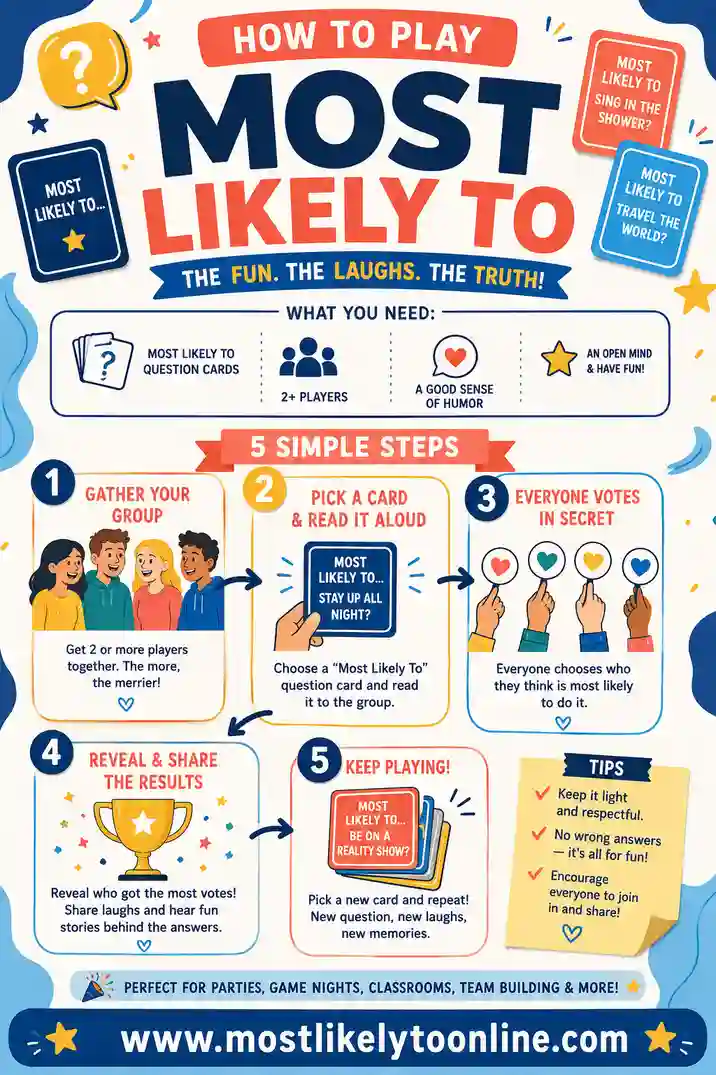
Most Likely To is the closest thing to Truth or Dare without the dares. Instead of asking someone to do something, you ask the whole group a "Most likely to…" question, and everyone votes on who fits best. "Most likely to become famous." "Most likely to forget their own birthday." "Most likely to text back in two seconds."
It's perfect as an alternative because:
- Nobody gets singled out unfairly. The group decides together, so it feels playful, not pointed.
- There's no performing. Shy people can play without ever being put on the spot.
- It scales. Three friends or thirty, it works the same.
- It's instant. Add names in the free game and start. No cards to buy, no app to download.
You can keep it clean for family game night or turn up the cheeky factor for an adults-only crowd. If you've never run it, our guide on how to play Most Likely To walks you through it, and the master question list gives you hundreds of prompts.
2. Would You Rather
Would You Rather hands everyone an impossible choice between two options. "Would you rather have unlimited tacos or unlimited pizza for life?" "Would you rather be able to fly or be invisible?"
It's a great alternative because the debates are half the fun. People argue, defend their picks, and learn surprising things about each other, all without anyone doing a dare. It works for road trips, dinner tables, and waiting rooms, and you can dial it from goofy to genuinely thought-provoking.
3. Never Have I Ever
In Never Have I Ever, one person says something they've never done ("Never have I ever broken a bone"), and anyone who has done it puts a finger down or takes a sip of their drink. It's a confession game that gets people swapping stories fast.
It keeps the spirit of Truth without the dares, and it's a brilliant icebreaker for groups that don't know each other well. Just agree on the vibe up front so the prompts stay comfortable for everyone present.
4. Two Truths and a Lie
Each person shares three statements about themselves: two true, one false. The group guesses which one is the lie. It's a quiet, clever game that's perfect for new groups, team-building, or anyone who'd rather think than perform.
The fun comes from how well you can fool people, and from the wild true stories that turn out to be real. No props, no pressure, no dares.
5. Charades
If your crowd has energy to burn, Charades brings the same animated chaos as a good dare round, minus the awkwardness. One person acts out a word or phrase while the others shout guesses. No talking allowed.
It's loud, silly, and active, which makes it great for parties where people want to be on their feet. Teams keep everyone involved, so nobody sits out.
6. The Question Game
This one's for groups that like to go a little deeper. Players take turns asking each other questions, and the only rule is you have to answer honestly. You can keep it light ("What's your comfort food?") or steer it meaningful ("What's a goal you've never told anyone?").
It captures the best part of "Truth" while letting people choose how vulnerable they want to be. Great for close friends, date nights, and long car rides.
7. Hot Seat
In Hot Seat, one person sits in the "hot seat" for a set time while everyone else fires rapid questions at them. They answer as many as they can. It's fast, personal, and a little thrilling, but unlike a dare, it stays in your comfort zone because you can always pass.
Set a timer, keep it kind, and rotate so everyone gets a turn.
8. Categories
Pick a category, like "ice cream flavors" or "movies from the 90s," and go around the circle naming items without repeating or hesitating. Mess up and you're out. It's quick, competitive, and easy to learn, making it a perfect filler game between bigger ones.
How to Pick the Right One for Your Group
Not sure which alternative to grab? Match the game to your crowd:
- Mixed ages or family: Most Likely To (kept clean) or Would You Rather.
- New group or coworkers: Two Truths and a Lie or Most Likely To as an icebreaker.
- High-energy party: Charades.
- Close friends who want laughs: Most Likely To or Never Have I Ever.
- Deeper conversation: The Question Game.
- Quick filler: Categories.
When in doubt, start with Most Likely To. It's the most flexible of the bunch, it needs nothing but a phone, and it pulls even the quiet folks into the fun. You can always roll into another game once everyone's warmed up.
Tips to Keep Any Game Fun and Comfortable
A few small habits make game night better no matter which alternative you choose:
- Agree on the vibe first. Clean, cheeky, or anything goes? A quick check keeps everyone relaxed.
- Let people pass. A no-pressure pass option means shy players stay in the game.
- Keep rounds short. Stop while it's still fun, not when it's fizzling.
- Mix games. Start with an icebreaker, then move to something deeper or louder.
- Read the room. If a prompt lands flat, move on. The goal is laughs, not awkward silence.
These work for every game on this list, and they're exactly why a group-vote game like Most Likely To tends to win the night.
Frequently Asked Questions
What is the best Truth or Dare alternative for all ages?
Most Likely To is the most family-friendly pick. Keep the questions clean and it works for kids, teens, and adults at the same table. The free game lets you add everyone's names and play with no setup, and our master question list has plenty of PG prompts.
Are these alternatives free to play?
Yes. Most Likely To, Would You Rather, Never Have I Ever, and the rest need no purchase. You just need a group and, for the online ones, a phone or screen. There's nothing to buy and nothing to install.
What's a good Truth or Dare alternative for shy people?
Most Likely To and Two Truths and a Lie are ideal because nobody has to perform. The group votes or guesses together, so shy players can join in without being put on the spot.
Can I play these alternatives online over video chat?
Absolutely. Most Likely To, Would You Rather, and Never Have I Ever all work great on a video call. One person shares their screen or reads the prompts aloud, and everyone votes or answers from home.
Which alternative is best for big groups?
Most Likely To and Charades both scale well past a dozen people. Most Likely To is especially easy for big crowds since the game handles the picking, and we've got a big-groups guide full of party-ready prompts.
How do I keep these games clean and advertiser-safe?
Choose a clean question set and skip anything risky. Most Likely To and Would You Rather are easy to keep PG, which makes them perfect for classrooms, family nights, and work events.
Ready to Play the Easiest Alternative?
If you want all the fun of Truth or Dare without the cringe, start with Most Likely To. Open the free game, add your friends' names, and let it pick who's most likely to do each hilarious thing. It's free, there's no sign-up, and it works for any group, any age, any time. Grab a few names and see who the group votes for first.