Most Likely To Icebreaker: 50 Questions to Break the Ice
A Most Likely To icebreaker is a quick group game where someone reads a "Most likely to…" question and everyone points at the person who fits it best. It's one of the fastest ways to warm up a room of people who don't know each other yet, because no one can answer "wrong" and everyone gets to laugh. It needs zero supplies and works at parties, in classrooms, at work events, and anywhere a group needs to loosen up. Grab the 50 icebreaker questions below and you're ready to go.
Running it for a big group? Open the free Most Likely To game, type in everyone's names, and it'll pick the "most likely" person for each question for you. No sign-up, nothing to install.
Why Most Likely To Is a Great Icebreaker
Icebreakers usually flop for one of two reasons: they're awkward, or they're boring. Most Likely To avoids both. It's about reading each other's personalities, which is exactly what a group needs to do to start feeling comfortable. People laugh, they make snap judgments about near-strangers, and somehow that breaks the tension instantly.
It also includes everyone automatically. The shy person in the corner gets pointed at and grins; the loud one gets to play it up. Within a handful of questions, a room of strangers feels like a group that's known each other longer than it has. That's the whole point of an icebreaker, and this game nails it.
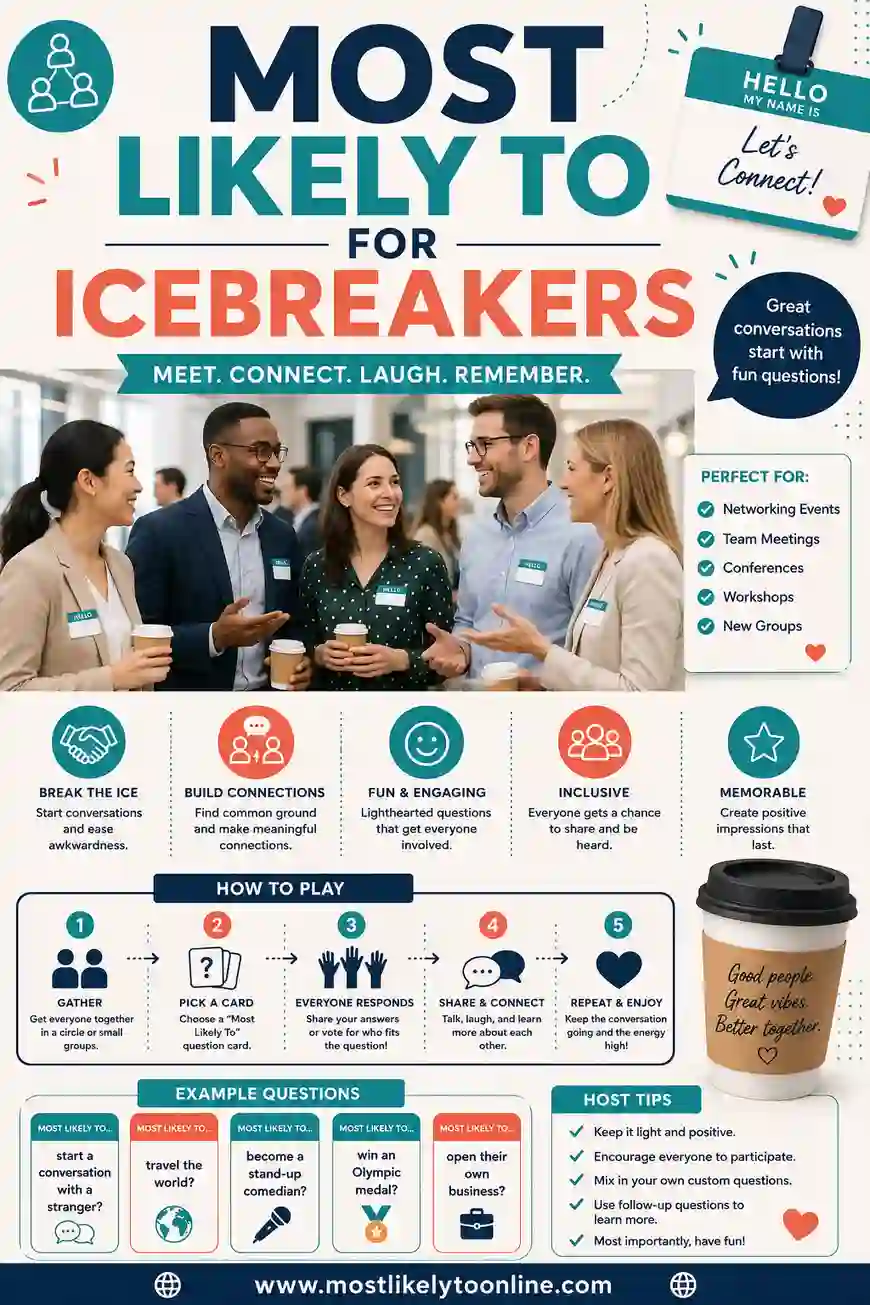
Here's the simple flow:
- Get the group sitting or standing so they can see each other.
- One person reads a "Most likely to…" question out loud.
- On the count of three, everyone points at the person who fits.
- The person with the most votes takes the prompt, and the group laughs.
- Read the next one and keep it moving.
No score, no winner needed. The magic is in the friendly debate over who's really most likely to talk to anyone in the room.
50 Most Likely To Icebreaker Questions (Copy & Paste)
Here are 50 icebreaker-friendly questions, all PG and built to work with people who barely know each other. They lean on universal traits and fun habits so anyone can be the answer. Copy the whole list or read straight off your phone.
Get-to-know-you
- Most likely to talk to anyone in the room
- Most likely to make a new friend instantly
- Most likely to remember everyone's name
- Most likely to start a conversation with a stranger
- Most likely to know a fun fact about everything
- Most likely to have traveled somewhere surprising
- Most likely to have a hidden talent
- Most likely to give the best advice
- Most likely to ask the most questions
- Most likely to be friends with everyone here by the end
Funny first impressions
- Most likely to laugh at their own joke
- Most likely to tell the best story
- Most likely to trip over nothing
- Most likely to make a dramatic entrance
- Most likely to have the most embarrassing ringtone
- Most likely to get lost on the way here
- Most likely to overpack for any trip
- Most likely to take the most photos today
- Most likely to have a wild dance move ready
- Most likely to crack the first joke in any room
Personality reveals
- Most likely to show up first to an event
- Most likely to be the last to leave a party
- Most likely to take charge in a group
- Most likely to volunteer to go first
- Most likely to plan the whole night
- Most likely to wing it and somehow succeed
- Most likely to cheer everyone up
- Most likely to stay calm in chaos
- Most likely to bring snacks to share
- Most likely to organize the group
Dreams and "somedays"
- Most likely to become famous one day
- Most likely to travel the world
- Most likely to start their own business
- Most likely to write a book
- Most likely to win a game show
- Most likely to learn a new language for fun
- Most likely to run a marathon
- Most likely to be a future leader
- Most likely to invent something useful
- Most likely to end up on TV
Group fun
- Most likely to win a trivia night
- Most likely to start a group chat after today
- Most likely to plan the next hangout
- Most likely to win a game of charades
- Most likely to get everyone laughing
- Most likely to suggest one more round
- Most likely to cheer the loudest
- Most likely to still be talking after the lights go out
- Most likely to make today memorable
- Most likely to be everyone's favorite person here
Want it to call out the real people in your group? Type their names into the online tool and let it pick who's most likely for each one. Hearing a near-stranger's name read out loud is exactly the kind of surprise that breaks the ice.
Add-Your-Names Mode (Perfect for Icebreakers)
The classic "point at a person" version works great, but the online tool adds a twist that's ideal for breaking the ice. You type in everyone's names, and the game randomly picks who's "most likely" for each question, even people who just met.
Why it's so good for a fresh group:
- It's neutral. The game picks, so no one feels singled out by a crowd of strangers.
- It surprises everyone. Random matches spark "wait, why them?" conversations that get people talking.
- It runs itself. The host or facilitator gets to join in instead of just reading.
You can pass one phone around or cast it to a screen so the whole room follows along. Either way, add everyone's names here and you're set.
Where to Use a Most Likely To Icebreaker
This game flexes to almost any setting where people need to warm up to each other.
At parties and gatherings
It's a perfect opener when guests don't all know each other. A few rounds and the room shifts from polite small talk to genuine laughter.
In classrooms
Teachers use it on the first day to help students learn names and personalities. Keep the questions light and school-appropriate, and even shy students get drawn in.
At work and team events
A clean round of Most Likely To beats a stiff "tell us a fun fact" every time. It works at onboarding, team off-sites, and retreats to get colleagues mixing.
At camps and retreats
Big groups of strangers bond fast with this. Run it on the first night and watch cliques dissolve before the weekend even starts.
Tips for a Smooth Round
A few small choices keep the game flowing.
- Start easy, then go bolder. Open with simple get-to-know-you questions, then move to the personality ones once people are comfortable.
- Keep it kind. Set one rule: silly, not mean. Aim at fun traits, never at someone's looks or insecurities.
- Read slowly. Give the group a beat to scan faces before the count of three.
- Keep rounds short. Fifteen to twenty questions is plenty to break the ice before you move on to the main event.
More Themes to Try Next
If your group loved this, keep the momentum going with these packs:
- Most Likely To for youth groups — clean questions tuned for teen groups and camps.
- Most Likely To for sports teams — perfect for team building and bonding.
- Most Likely To for sleepovers — fun for overnight events and lock-ins.
They all play the same easy way, or load them into the free tool and let it run the round for you.
Frequently Asked Questions
Why is Most Likely To a good icebreaker?
Because it's about reading each other's personalities, not knowing facts, so no one can answer "wrong." Everyone gets included, the laughs come fast, and a room of strangers feels comfortable within a few questions. That's exactly what an icebreaker is supposed to do.
How many people do you need?
It works with as few as four and scales to fifty or more. For bigger groups, the online game helps by picking the most likely person for you instead of counting a crowd of pointing fingers.
Is it appropriate for work or school?
Yes. Every question on this page is PG and focused on fun traits and habits, not anything inappropriate. It's a safe, lively alternative to standard work and classroom icebreakers. Just skim the list and pick what fits your group.
Do we need any materials?
None. You only need the list of questions, which you can copy from above or open in the free tool. No cards, no app, no printing, which makes it perfect for a last-minute icebreaker.
How long should an icebreaker round take?
About five to ten minutes, or fifteen to twenty questions, is the sweet spot. That's enough to warm up the group without dragging before the main activity. You can always run another round later.
How do I keep it from getting awkward?
Start with easy get-to-know-you questions before the bolder ones, and set a "silly, not mean" rule up front. Aim prompts at fun habits and positive traits so everyone laughs together. If a question ever lands wrong, just skip it and move on.
Ready to Break the Ice?
Copy the 50 questions above, gather your group, and start pointing. Or make it effortless and open the free Most Likely To game, add everyone's names, and let it run the round for you. It's free, there's no sign-up, and it's one of the fastest ways to turn a room of strangers into a group that's laughing together within minutes.