Most Likely To for Youth Groups: 50 Clean Questions
Most Likely To for youth groups is a quick, clean game where a leader reads a "Most likely to…" question and everyone points at the person who fits it best. It's a go-to icebreaker for teen groups, church youth nights, summer camps, and after-school clubs because it needs no supplies, includes everyone, and gets a room laughing in seconds. Grab the 50 wholesome questions below and you can start right now.
Leading a big group? Open the free Most Likely To game, type in everyone's names, and it'll pick the "most likely" person for each question for you. No sign-up, no app to download.
Why Most Likely To Is Perfect for Youth Groups
Youth leaders know the challenge: you've got a room full of teens, some who've been friends for years and some who walked in for the first time tonight. You need something that breaks the ice fast, includes everyone, and stays completely clean. Most Likely To checks every box.
It works because it's about people, not knowledge. No one can answer it "wrong." Quiet kids get pointed at and laugh; outgoing kids get to ham it up. Within a few questions, the room feels warmer and the new faces feel like they belong. That's exactly what a youth group leader is after.
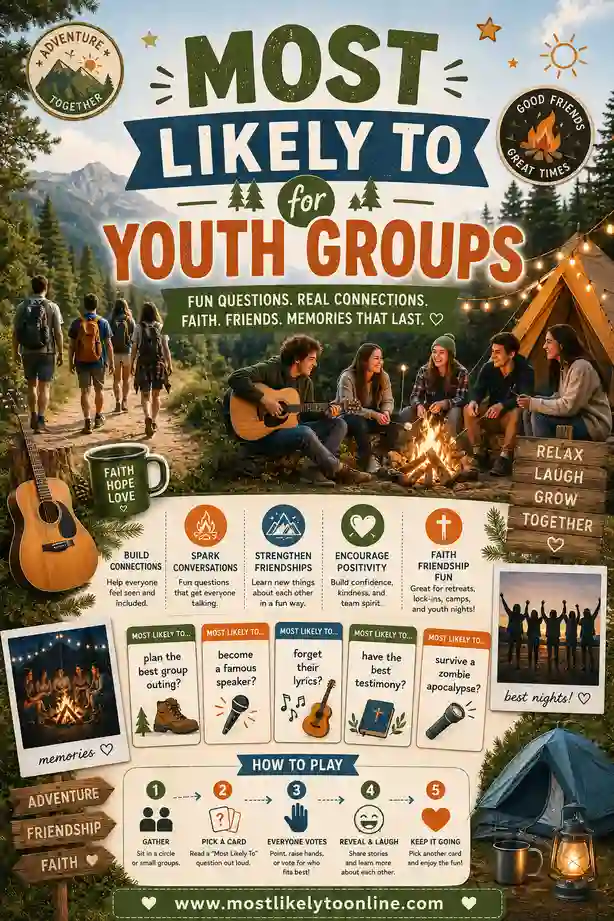
Here's the simple flow:
- Get the group sitting in a circle or facing each other.
- A leader (or a volunteer) reads a "Most likely to…" question.
- On the count of three, everyone points at the person who fits.
- The person with the most votes takes the prompt, and everyone has a laugh.
- Read the next one and keep it rolling.
No score, no losers, no pressure. Just a fast, friendly way to help a group click.
50 Most Likely To Questions for Youth Groups (Copy & Paste)
Here are 50 clean, upbeat questions made for teen and youth settings. They highlight kindness, humor, and personality, never anything inappropriate. Copy the whole list or read straight off your phone.
Kindness and character
- Most likely to help a stranger without being asked
- Most likely to encourage someone who's having a rough day
- Most likely to include the new person
- Most likely to give the best advice
- Most likely to volunteer for anything
- Most likely to share their snacks
- Most likely to remember everyone's name on day one
- Most likely to stand up for a friend
- Most likely to send an encouraging text out of nowhere
- Most likely to lead by example
Funny and lighthearted
- Most likely to laugh at their own jokes
- Most likely to tell the funniest story
- Most likely to trip over absolutely nothing
- Most likely to make a dramatic entrance
- Most likely to have the wildest dance moves
- Most likely to do an impression of the leader (kindly!)
- Most likely to start an inside joke that lasts all year
- Most likely to laugh at the wrong moment
- Most likely to fall asleep during movie night
- Most likely to wear something unforgettable
Group life
- Most likely to show up early to everything
- Most likely to be late to the meeting
- Most likely to plan the next group hangout
- Most likely to start a group chat
- Most likely to organize a fundraiser
- Most likely to bring snacks for everyone
- Most likely to suggest a new game to play
- Most likely to remember every birthday
- Most likely to invite a friend along
- Most likely to keep the group together
Talents and dreams
- Most likely to become a famous YouTuber
- Most likely to start their own business
- Most likely to write a book one day
- Most likely to travel the world
- Most likely to become a teacher
- Most likely to win a talent show
- Most likely to learn a new instrument over the summer
- Most likely to run a marathon
- Most likely to invent something useful
- Most likely to lead a group of their own someday
Camp and events
- Most likely to win a game of charades
- Most likely to get everyone singing along
- Most likely to cheer the loudest at a game
- Most likely to make a new friend instantly
- Most likely to be the camp counselor everyone loves
- Most likely to stay up latest at the lock-in
- Most likely to win the talent night
- Most likely to volunteer to go first
- Most likely to bring the most energy to an event
- Most likely to make everyone feel welcome
Want it to call out your actual group members? Type their names into the online tool and let it pick who's most likely for each one. Hearing a friend's name read out loud always gets the biggest laugh.
Add-Your-Names Mode for Leaders
The classic "point at a person" version is great, but youth leaders love the online tool because it does the work for you. Type in the group's names once, and the game randomly picks who's "most likely" for each question.
Why it shines in a youth-group setting:
- It keeps things fair. The game picks, so no one feels ganged up on by the group vote.
- It surprises everyone. Random matches are funnier than what people would have guessed.
- It frees up the leader. Project it on a screen and let the game run the round.
You can pass one phone around the circle or cast it to a TV for the whole room to follow. Either way, add your group's names here and you're ready.
Tips for Leaders
A few small choices make the game land even better with teens.
Read the room first
Skim the question list before the meeting and pick the ones that fit your group's age and vibe. The list above is clean across the board, so you can use any of them with confidence.
Use it as a warm-up
Most Likely To is a perfect first activity. Run five minutes of it to loosen everyone up before you move into the main lesson, game, or discussion.
Keep it kind, not cutting
Set one rule out loud: silly, not mean. Aim questions at positive traits and funny habits, never at someone's looks or insecurities. The goal is for everyone to leave feeling included.
Let kids lead
Hand the question list to a student and let them run a round. It builds confidence and gives them a small leadership win in a low-stakes setting.
Turn the Game Into a Conversation Starter
Most Likely To does more than fill five minutes. With a small tweak, it becomes a doorway into the kind of real conversation youth leaders are always hoping for. After a few light rounds, slow down and ask a follow-up when a question lands well.
For example, after "most likely to encourage someone who's having a rough day," you might ask, "When was a time someone encouraged you?" Suddenly the laughing group is sharing something real, and you barely had to steer it. The game did the warming up for you.
A few easy follow-ups that work after the right prompt:
- After a kindness question: "Who in your life is good at this, and what do they do?"
- After a dreams question: "What's one small step toward that you could take this year?"
- After a humor question: "What's a time you made a whole group laugh?"
You don't have to do this every round. Sprinkle it in once or twice and let the rest stay purely for fun. The mix of laughter and a little depth is what makes teens actually look forward to youth group instead of just showing up.
Common Mistakes to Avoid
A few small missteps can take the air out of an otherwise great round. Here's what to watch for.
- Letting it run too long. Energy peaks early. Stop while everyone still wants more, not after they've checked out.
- Aiming questions at the same person. If the group keeps pointing at one student, switch to questions that spread the spotlight around.
- Skipping the ground rule. Always say "silly, not mean" before you start. It takes five seconds and prevents hurt feelings.
- Forcing the shy ones to defend themselves. Let students laugh and move on. No one should feel cornered into explaining a vote.
- Reading too fast. Give the group a beat to look around. The pause before "three" is where the fun builds.
Avoid these and your round will land every time. The game is nearly foolproof, but a thoughtful leader makes it genuinely memorable.
More Themes to Try Next
If your group loved this, keep the energy going with these packs:
- Most Likely To icebreaker — extra get-to-know-you questions for new groups.
- Most Likely To for sports teams — great for youth sports and camp teams.
- Most Likely To for sleepovers — perfect for lock-ins and overnight retreats.
They all play the same easy way, or load them into the free tool and let it run the round for you.
Frequently Asked Questions
Are these questions appropriate for a church or school youth group?
Yes. Every question on this page is clean, positive, and focused on kindness, humor, and personality. There's nothing inappropriate, so leaders can use any of them with confidence in a faith-based or school setting.
How big can the group be?
Any size works, from a small circle of six to a packed room of fifty. For bigger groups, the online game makes it easier by picking the most likely person for you instead of counting dozens of pointing fingers.
What ages is this good for?
It's a great fit for tweens and teens, roughly ages 10 to 18, which covers most youth groups, camps, and clubs. The questions also work fine for adult small groups. Just match the prompts to your crowd.
Do we need any materials?
None at all. You only need the list of questions, which you can copy from above or open in the free tool. No cards, no app, no printing. That makes it perfect for a last-minute icebreaker.
How do I keep the game from turning mean?
Set one clear rule before you start: keep it silly, not savage. Aim questions at funny habits and good qualities, never at someone's appearance or a sensitive spot. If a prompt ever feels like it's hurting instead of helping, skip it and move on.
Can I use it for an icebreaker on the first night?
Definitely. It's one of the best first-night activities because no one can answer "wrong" and it instantly gets people interacting. Pair it with name tags or a quick name game so new members can point with confidence.
Ready to Break the Ice?
Copy the 50 clean questions above, gather your group, and start pointing. Or make it effortless and open the free Most Likely To game, add everyone's names, and let it run the round for you. It's free, there's no sign-up, and it's one of the simplest ways to help a youth group laugh together and feel like one team from the very first meeting.