13 Fun Games Like Most Likely To (Free & Easy)
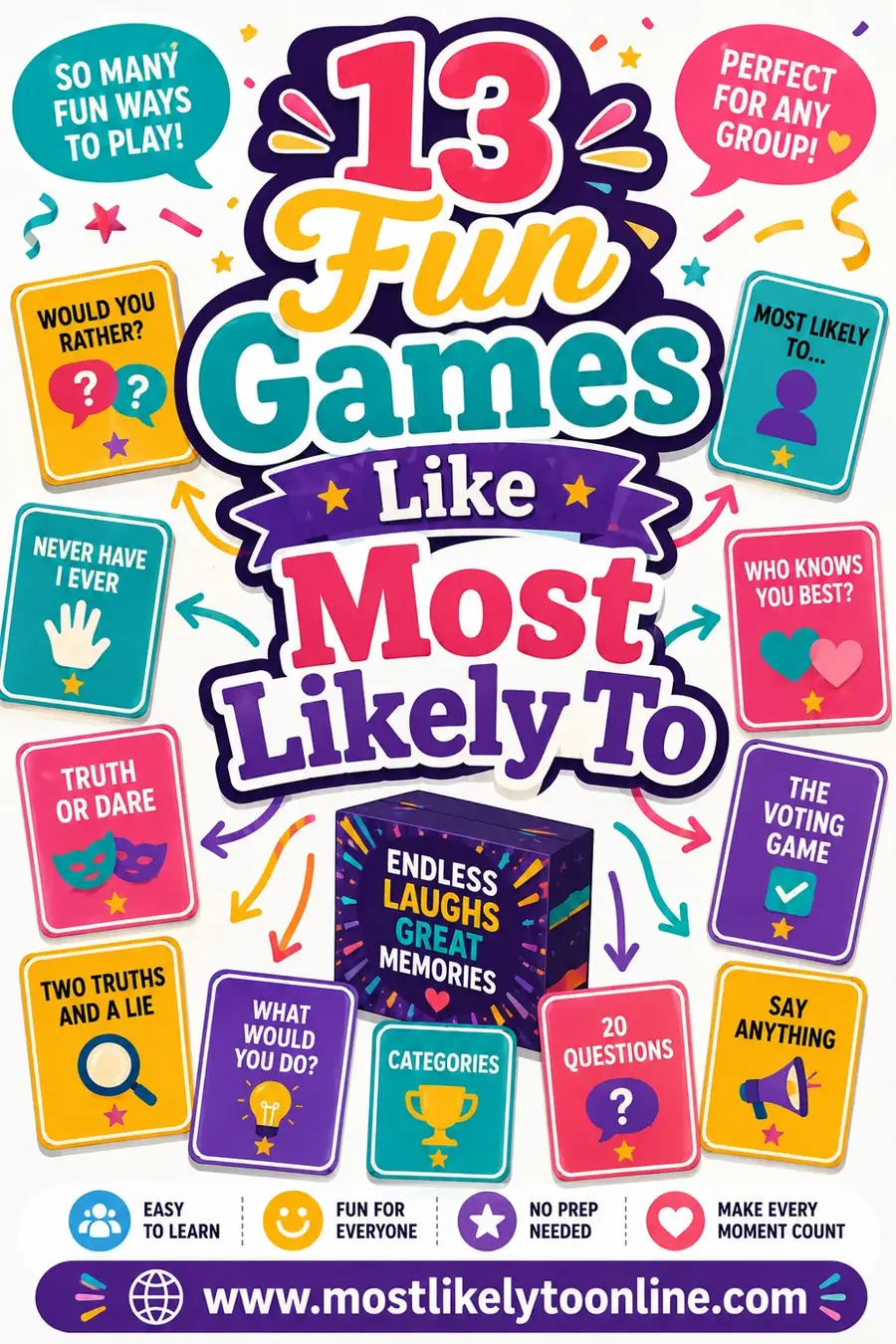
Games like Most Likely To are simple, no-prep party games where you read a prompt and the group reacts, votes, or confesses. The closest cousins are Never Have I Ever, Would You Rather, Two Truths and a Lie, and Truth or Dare — all built on the same "read a card, get a reaction" magic. If you want the original, Most Likely To is free, needs no setup, and picks who's "most likely" the moment you add names.
Already a fan and looking for variety? Open the free Most Likely To game for the classic, then use this list to mix in 13 similar games that keep your party fresh. Below you'll find what each game is, how it compares, and which crowd it suits best.
Why People Love Most Likely To
Before the alternatives, it's worth naming what makes Most Likely To so good. Understanding the appeal helps you pick games that scratch the same itch.
- Instant start. No board, no cards to buy, no rules to memorize. You read a prompt and play.
- Everyone plays at once. The whole group votes together, so nobody waits their turn.
- Inside jokes for days. Voting on who's "most likely" creates moments friends quote for weeks.
- Scales to any size. It works for two people or a packed room of thirty.
- Endless replay. Swap the question list and it feels brand new every time.
The games below capture one or more of these traits. We'll start with the closest matches and work outward.
The 13 Best Games Like Most Likely To
1. Never Have I Ever
The closest sibling. Everyone holds up ten fingers, a prompt is read, and anyone who's done that thing drops a finger. Like Most Likely To, it's a read-and-react confession game with zero setup. Keep prompts friendly for a mixed crowd and it's a guaranteed hit.
2. Would You Rather
Pose an impossible choice — "Would you rather always be ten minutes late or twenty minutes early?" — and let the group debate or vote. It has the same quick, no-props energy and sparks the same fun arguments.
3. Two Truths and a Lie
Each person shares three statements; the group guesses the lie. It swaps voting on others for sharing about yourself, but keeps the warm, get-to-know-you vibe that makes Most Likely To great as an icebreaker.
4. Truth or Dare
The party classic. Players choose a truth question or a dare challenge. It's a bit bolder than Most Likely To, but shares the read-a-prompt structure. Keep dares silly and truths kind for a clean version anyone can play.
5. This or That
Rapid-fire either-or questions — "beach or mountains," "sweet or salty." Players pick a side fast. It's an even simpler cousin, perfect as a warm-up or for younger groups.
6. Hot Seat
One person sits in the "hot seat" and the group fires friendly questions at them for a minute. It flips the spotlight but keeps the same casual, conversational feel.
7. Paranoia
One player whispers a "who's most likely to…" question to their neighbor, who answers out loud with a name — but the rest of the group never hears the question. It's a sneaky, suspenseful twist on the Most Likely To format.
8. Categories
Pick a topic and go around naming items without repeating or stalling. It's less confessional and more competitive, but it shares the quick, no-props, everyone-stays-involved appeal.
9. Charades
Act out a word or phrase with no talking while your team guesses. More active than Most Likely To, but it's another zero-cost classic that gets the whole group laughing.
10. The Hat Game (Celebrity)
Write famous names on slips and describe, act, and one-word them across three rounds. It builds energy over time and, like Most Likely To, gets the whole room shouting together.
11. Group Storytelling
One person starts a story and each adds a sentence until it spirals into chaos. It's a creative, low-key option with the same no-materials simplicity.
12. Heads Up
One player holds a word on their forehead while the group gives clues. Fast and frantic, it's a phone-friendly favorite that pairs perfectly with Most Likely To on a game night.
13. Trivia
Split into teams and answer themed questions across rounds. It's brainier than Most Likely To, but it's another flexible, no-prep way to keep a group entertained for an hour.
Quick Comparison: How These Games Stack Up
Here's how the alternatives compare to Most Likely To at a glance.
| Game | Setup | Group size | Style | How similar |
|---|---|---|---|---|
| Most Likely To | None | 2–30+ | Vote on a friend | The original |
| Never Have I Ever | None | 4–20 | Confess | Very similar |
| Would You Rather | None | 2–20 | Debate / vote | Very similar |
| Paranoia | None | 4–12 | Secret guess | Very similar |
| Two Truths and a Lie | None | 4–15 | Share / guess | Similar |
| Truth or Dare | None | 4–12 | Prompt / dare | Similar |
| This or That | None | Any | Quick pick | Similar |
| Charades | Low | 6–20 | Act out | Different but classic |
| Trivia | Medium | 4–24 | Answer questions | Different but easy |
How to Mix These Games Into One Great Night
You don't have to pick just one. The best game nights flow from one game to the next.
- Open easy. Start with Most Likely To or This or That so everyone warms up without pressure.
- Go deeper. Move into Never Have I Ever or Two Truths and a Lie once people are comfortable.
- Raise the energy. Bring in charades, Heads Up, or the Hat Game when the room needs a spark.
- Cool down. Wind down with Would You Rather or group storytelling before the night ends.
- Loop back. Most Likely To is a reliable closer too — pull up the free game and run one last round.
The trick is reading the room. If a game starts to drag, switch fast. Keeping two or three options ready means you never lose the momentum.
Common mistakes when mixing party games
A great lineup can still stumble if you trip over these. Keep them in mind.
- Switching too often. Bouncing between games every five minutes is jarring. Let each one breathe before moving on.
- Stacking similar games back to back. Three confession games in a row feels repetitive. Alternate styles to keep variety.
- Forgetting to explain the swap. When you change games, take ten seconds to set up the new rules so nobody's lost.
- Ignoring the energy curve. Don't end on your most intense game. Wind down so people leave relaxed, not wound up.
- Overplanning. You don't need a strict schedule. Have a few options ready and follow the room's mood.
Which Game to Pick for Your Crowd
The right alternative depends on who you're playing with. Here's a quick guide.
- A group that just met. Start with Two Truths and a Lie or Most Likely To. They help people learn names and break the ice without pressure.
- Close friends. Never Have I Ever, Paranoia, and Truth or Dare bring out the inside jokes and the laughs that only old friends can share.
- A mixed-age family group. Keep it gentle with This or That, Would You Rather, and friendly Most Likely To prompts everyone can join.
- A high-energy party. Charades, Heads Up, and the Hat Game get the whole room loud and moving.
Whatever you pick, Most Likely To is a safe bet to anchor the night. It works for any crowd, costs nothing, and gives you a reliable round to fall back on whenever the energy needs a lift.
Sample "Most Likely To" Questions to Get Started
New to the original or just want a quick batch? Read these out loud and vote, or let the free tool pick a name.
- Most likely to become famous
- Most likely to laugh at the wrong moment
- Most likely to plan the whole trip
- Most likely to text back in two seconds
- Most likely to win a dance-off
- Most likely to adopt a stray pet
- Most likely to start a group chat tonight
- Most likely to give the best advice
- Most likely to tell the longest story
- Most likely to win every board game
- Most likely to befriend a stranger
- Most likely to stay up the latest
- Most likely to quote a movie all night
- Most likely to always be running late
- Most likely to remember everyone's birthday
Want hundreds more? Browse our master question list, the questions for friends pack, or the deep questions edition for a more thoughtful round.
Frequently Asked Questions
What game is most like Most Likely To?
Never Have I Ever is the closest match — both are no-setup confession games where you read a prompt and the group reacts. Would You Rather and Paranoia are also very similar. For the original, the free Most Likely To game starts in seconds.
Are there free online games like Most Likely To?
Yes. Most Likely To is free to play online with no sign-up, and many similar games (Never Have I Ever, Would You Rather, This or That) need nothing but a prompt and a group. You can run a whole game night for free.
What games are good if my group is tired of Most Likely To?
Mix in Never Have I Ever, Two Truths and a Lie, charades, or trivia to keep things fresh. Rotating between a few similar games gives your group variety while keeping the easy, no-prep feel they love.
Can I play these games with a small group?
Absolutely. Most Likely To, Would You Rather, This or That, and Two Truths and a Lie all work with just two or three people. Bigger games like charades and trivia shine with larger crowds.
What's the best game like Most Likely To for an icebreaker?
Most Likely To itself is a top icebreaker, along with Two Truths and a Lie and This or That. They get people talking and laughing fast without putting anyone on the spot, which is exactly what you want early on.
Ready to Play the Original?
Games like Most Likely To are everywhere, but the original is still the easiest to start and the most fun to replay. Open the free game, add your friends' names, and let it pick who's "most likely" round after round. No sign-up, no cost, and every game is different. Bookmark this list, mix in a few cousins, and your next game night is set.