Most Likely To Card Game vs Online: Which Wins?
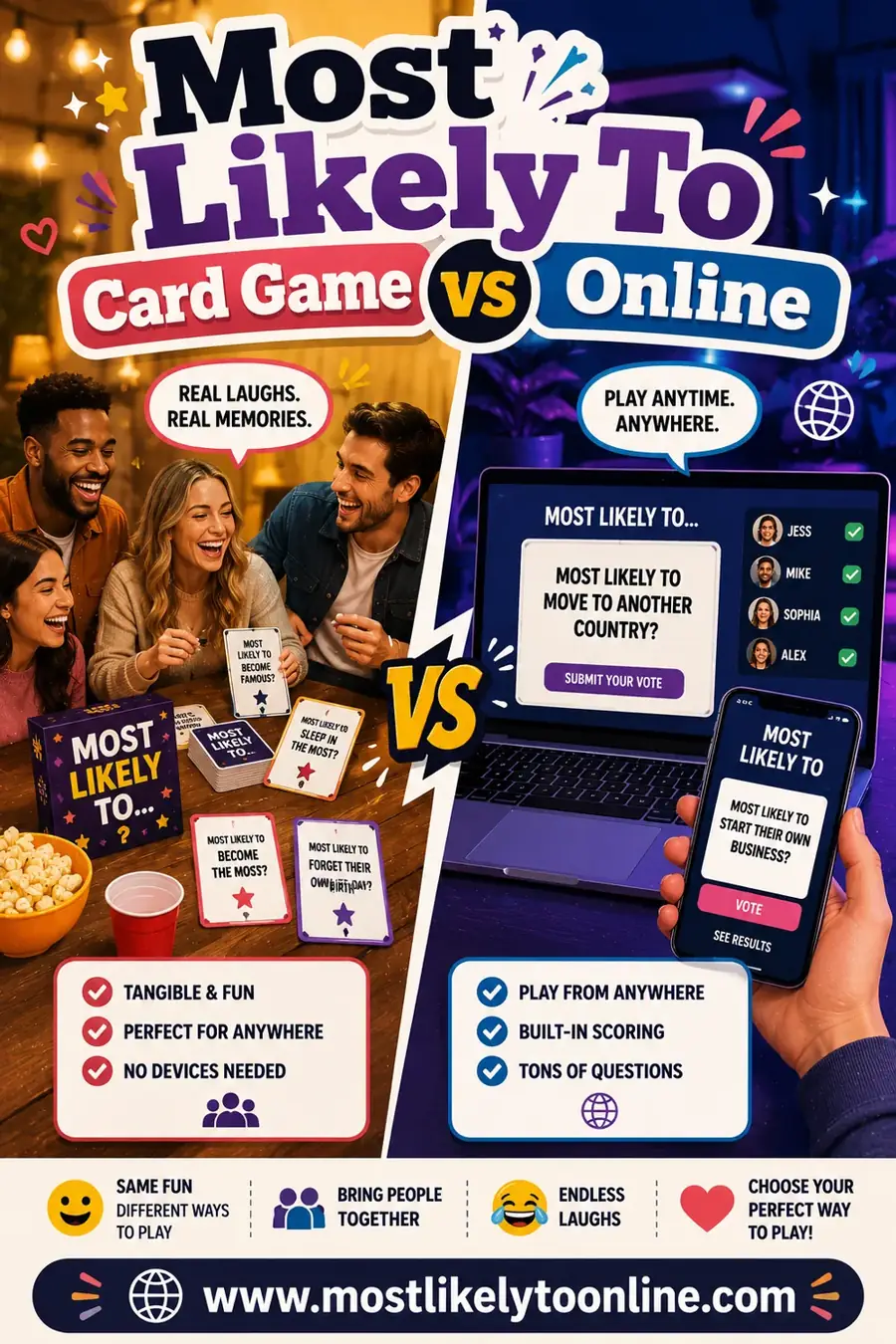
In the Most Likely To card game vs online debate, the online version wins for most groups: it's free, needs no setup, picks a player for you, and offers far more questions than any boxed deck. A physical card game is nice for screen-free nights and gifts, but you pay for it, carry it, and run out of fresh questions fast. For instant, personalized play, a free generator like mostlikelytoonline is the easy pick.
Want to compare them yourself? Open the free Most Likely To game, add your friends' names, and you'll see how fast online play gets going. Below, we break down both options side by side so you can choose with confidence.
The Quick Answer
If you want the short version: online play is faster, cheaper, and endlessly fresh, while a physical card game is tactile, screen-free, and makes a nice gift. Most people having a party tonight should go online. People who love board-game nights and unplugging might prefer the cards. Both are fun, so it really comes down to your situation.
We'll dig into each factor below, but here's the headline: you can be playing online in under a minute, and a free generator never runs out of questions.
Side-by-Side Comparison
Here's the whole comparison in one table.
| Factor | Online generator | Physical card game |
|---|---|---|
| Cost | Free | $15–$30 typically |
| Setup | Open a link, add names | Unbox, shuffle, deal |
| Questions | Hundreds, always fresh | Fixed deck, repeats |
| Picks a player for you | Yes (combo tools) | No, group decides |
| Works for big groups | Yes, share one screen | Yes, but pass the deck |
| Needs power/internet | Yes | No |
| Screen-free | No | Yes |
| Travel-friendly | Yes (on your phone) | Bulkier to carry |
| Great as a gift | Not really | Yes |
The table makes the trade-off clear. Online wins on cost, speed, and variety. Cards win on the screen-free, giftable, no-battery side.
Where Online Play Wins
For most game nights and parties, the online version has real advantages.
It's free
A boxed card game costs money. A free online generator costs nothing, and there's no sign-up. You can run a whole party without spending a cent. See our best apps and generators roundup for free picks.
It's instant
There's no unboxing or shuffling. You open the game, type in names, and play. From "let's play something" to actually playing is under a minute. A card game means finding the box, reading the rules, and dealing out cards first.
The questions never run out
A physical deck has a fixed number of cards. Play it a few times and you'll start seeing repeats. A good online generator pulls from hundreds of questions, so the game stays fresh for months. Our questions master list shows just how deep the well goes.
It picks a player for you
Add everyone's names and the tool can randomly crown a "winner" for each question. No arguing, no awkward group-pointing if your crowd would rather keep it hands-off. With a card game, your group always has to decide together.
It scales to big groups easily
Got fifteen people? Share one screen and everyone plays. The name picker keeps it moving so nobody's left out. Our big groups guide has tips for running it with a crowd.
Where the Card Game Wins
Physical cards aren't obsolete. They shine in a few situations.
It's screen-free
If you're tired of staring at phones, a card game is a refreshing break. It's tactile, you hold the cards, and there's no temptation to check notifications mid-game. Great for a cozy unplugged night.
It works with no battery or signal
A deck of cards never needs charging and never loses reception. For a campsite, a cabin, or a long flight, that's a real plus. (Though a printable list also covers this, more on that below.)
It makes a nice gift
You can't wrap a website. A boxed game looks great on a shelf and makes an easy present for a friend who loves party games. If gifting is your goal, the physical version wins by default.
It feels like an event
Pulling out a board game has a certain ceremony to it. For some groups, the act of gathering around a physical game is part of the fun.
A Third Option: Printable Cards
You don't have to choose between a screen and an expensive box. A free printable falls right in the middle. You print a sheet of questions (or use a free online list), and you get a screen-free, no-cost deck you can read aloud anywhere.
Printables give you the unplugged feel of cards with the price tag of online play. The catch is no automatic name picker and whatever questions you printed. Still, for a road trip or a classroom, they're a smart compromise. You can pull questions straight from our master list and print your own deck for free.
Cost Over Time
It's worth thinking past the first night.
- Online: Free forever. Play every weekend and you've spent nothing.
- Printable: Free, plus a little paper and ink.
- Physical card game: A one-time cost, but the questions are fixed. Want fresh content later? You buy an expansion or a new box.
If you play often, the online version saves real money over a year, and it never goes stale. If you play once or twice and value the object itself, the card game's cost may be worth it to you.
Which Should You Pick?
Here's a simple way to decide.
- Choose online if you want to play right now, you're hosting a party, you have a big group, you don't want to spend money, or you hate running out of questions. Start at the free game.
- Choose a physical card game if you want a screen-free night, you're buying a gift, or you love the ritual of a boxed game.
- Choose a printable if you want screen-free and free, like for a road trip, camp, or classroom.
For most readers, online is the right first move. It costs nothing to try, so you can always test it tonight and buy a physical deck later if your group prefers cards.
Frequently Asked Questions
Is the online Most Likely To better than the card game?
For most groups, yes, because it's free, instant, picks a player for you, and never runs out of questions. A physical card game is better if you want a screen-free night or a gift. Both are fun, so it depends on whether you value speed and variety or the tactile, unplugged feel.
Is the online Most Likely To game free?
Yes. A generator like mostlikelytoonline is free to use with no sign-up, so you can run a whole party without paying. A physical card game has a one-time cost, usually somewhere between fifteen and thirty dollars.
Does the online version have more questions than a card deck?
Almost always. A boxed deck has a fixed number of cards, so you'll see repeats after a few plays. A good online generator draws from hundreds of questions, keeping the game fresh much longer. You can browse the depth in our questions master list.
Can I play Most Likely To without a screen?
Yes. Buy a physical card game, or print a free question list and read it aloud. Both give you a screen-free game. The trade-off is you lose the automatic name picker and the endless fresh questions that the online version offers.
Which is better for a big group?
Online is usually easier for big groups. You share one screen and the name picker keeps everyone included, so the game flows without anyone keeping score. A card deck works too, but passing cards around a large circle can slow things down.
Can I try online before buying a card game?
Definitely, and we'd recommend it. The online version is free, so you can play a few rounds tonight at no cost. If your group loves it but wants a screen-free option, you can always pick up a physical deck afterward.
Real-World Scenarios
Sometimes the easiest way to choose is to picture the actual moment. Here are a few common ones.
Friday-night get-together
Friends drop by, snacks come out, and someone says "let's play something." You don't want to dig through a closet for a box or read a rulebook. Open the online game, type names, and you're playing before the pizza arrives. Online wins this one easily.
Family holiday gathering
Mixed ages, from kids to grandparents, all in one room. A physical deck works, but a generator with PG questions lets you share one screen and include everyone with a name picker. Either works, though online keeps the youngest players involved without anyone tracking turns.
Cabin weekend with no Wi-Fi
No signal, no problem for a physical deck. This is where cards (or a printed list you brought along) genuinely beat the online version. If you know you'll be off-grid, pack a deck or print questions ahead of time.
Birthday gift for a game lover
You can't gift a website. A nicely boxed card game wrapped with a bow is a thoughtful present for a friend who collects party games. Cards win here, hands down.
Seeing the moment makes the choice obvious. Most everyday "let's play now" situations favor online, while planned screen-free events and gifts favor cards.
Tips for Getting the Most Out of Either Version
Whichever you choose, a few small moves make the game better.
- Use real names. The game is funniest when it's about the actual people in the room. Online makes this automatic; with cards, just point at someone.
- Keep rounds short. End while people still want more. A dozen good questions beats forty so-so ones.
- Mix in a few personal prompts. Inside jokes and shared memories always get the biggest reactions.
- Let everyone get a turn in the spotlight. Don't let it always land on the loudest person. A name picker helps with this online.
- Pair it with another game. Follow a Most Likely To round with Would You Rather or Never Have I Ever to keep the night fresh.
These work for both formats, but online makes a couple of them effortless thanks to the built-in name picker and endless question bank.
The Verdict
If you want to play tonight, save money, and never run out of questions, go online. Open the free Most Likely To game, add your friends' names, and you'll see why it's the easy pick for most groups. If you'd rather unplug or need a gift, a physical card game has its place, and a free printable splits the difference. Whatever you choose, the real fun comes from your own crowd and the laughs you'll share. For more on free options, see our best party game websites and apps and generators guides.