Most Likely To for Large Groups: How to Play + 50 Qs
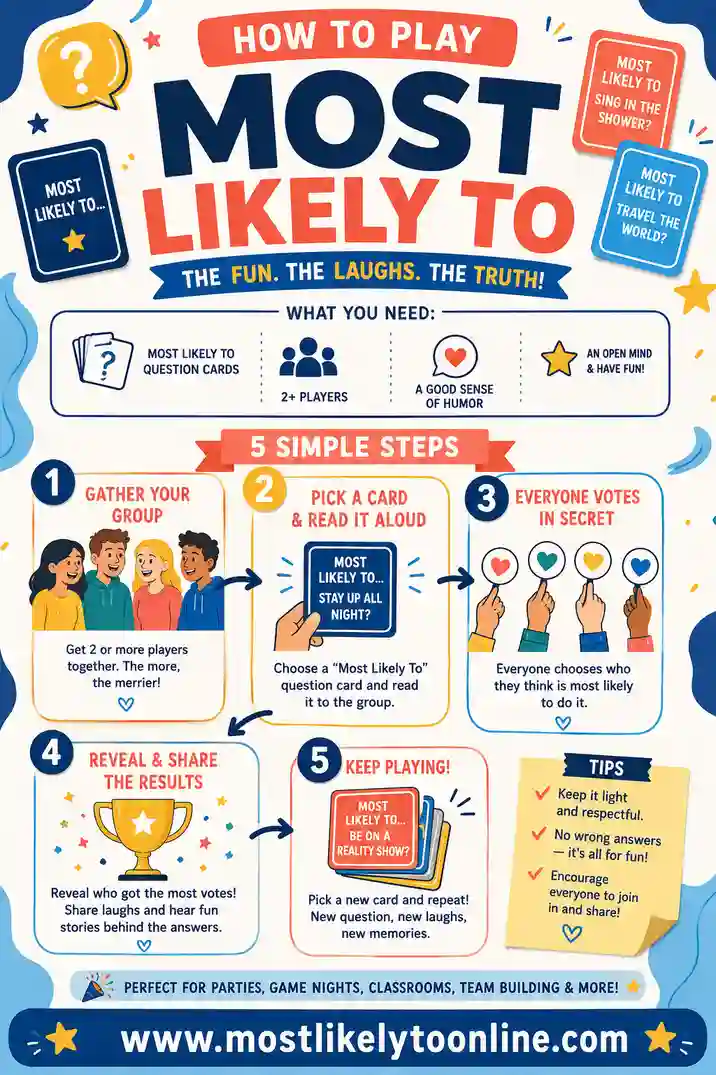
Most Likely To for large groups works by reading a "Most likely to…" prompt, having everyone point at the person who fits, and crowning whoever gets the most points, except with a crowd, you need a few tricks to keep it fast and fair. The simplest way to run it for twenty, fifty, or a hundred people is to load everyone's names into a free Most Likely To generator so it picks a random person for each question and no one waits around.
Hosting a big crowd? Open the free tool, add the names, and it'll handle the picking for you. Below you'll find proven ways to keep a large group involved, plus a 50-question list ready to copy and paste.
Why Large Groups Need a Different Approach
The classic version, read a prompt, everyone points, count the fingers, works beautifully for six or eight people. With a crowd of thirty, counting fingers turns into chaos. People can't see each other, the tally takes forever, and the energy drains.
So large groups need two small changes:
- Speed up the "picking." Instead of counting every finger, use the free generator to choose a random person, or run a quick show of hands by section.
- Break the crowd into circles. Smaller pods of eight to twelve keep everyone close enough to see and laugh together.
Get those two things right and a game that would stall with forty people suddenly hums along. The rest of this guide shows you exactly how.
How to Play Most Likely To with a Big Crowd
Here's the step-by-step for keeping a large group moving.
- Decide your format. One big game, or several smaller circles? Circles of eight to twelve work best for crowds over twenty.
- Load the names into the tool. The generator holds your whole roster and picks a random person per question, no manual counting.
- Assign a host per circle. In each pod, one person reads prompts and keeps the pace.
- Read a prompt and pick fast. Either let the tool name someone, or do a quick "point on three" within the small circle.
- Celebrate and move on. Give the winner a quick cheer, then straight to the next question. Speed keeps energy high.
- Rotate if you like. Every ten minutes, mix the circles so people meet new faces.
The golden rule for big groups: keep it fast. A question every 15 to 20 seconds beats a slow tally any day.
50 "Most Likely To" Questions for Large Groups
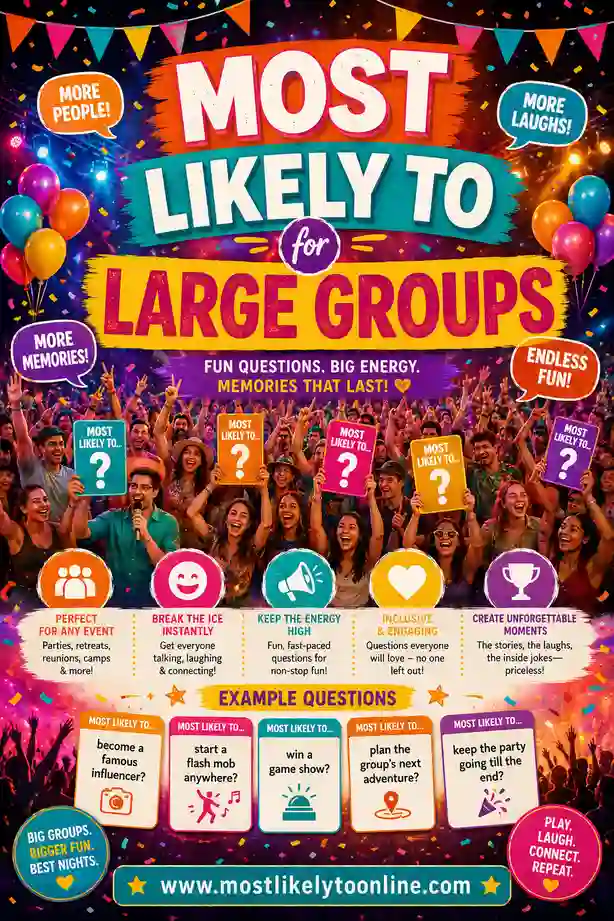
Here's your copy-paste list, built for crowds. These work for company parties, reunions, retreats, and any big gathering. Paste your favorites into the generator.
Leadership & social
- Most likely to take charge of the group
- Most likely to make a new friend instantly
- Most likely to organize everyone for a photo
- Most likely to remember everyone's name
- Most likely to plan the next big event
- Most likely to volunteer to go first
- Most likely to keep the whole group laughing
- Most likely to help a stranger out
- Most likely to start a group chant
- Most likely to break the ice with a new person
- Most likely to give a great toast
- Most likely to lead a team to victory
- Most likely to settle a friendly argument
- Most likely to welcome the newcomers
- Most likely to keep everyone on schedule
Funny & memorable
- Most likely to tell the funniest story
- Most likely to get lost on the way
- Most likely to laugh at the wrong moment
- Most likely to start a dance circle
- Most likely to win a staring contest
- Most likely to quote a movie all day
- Most likely to trip over nothing
- Most likely to fall asleep mid-event
- Most likely to lose their phone in the crowd
- Most likely to wear the boldest outfit
- Most likely to start a friendly prank war
- Most likely to mix up everyone's names
- Most likely to repeat the same joke all day
- Most likely to be the loudest in the room
- Most likely to do a silly dance
Talents & competition
- Most likely to win a game of trivia
- Most likely to win a relay race
- Most likely to be a karaoke star
- Most likely to ace a quiz
- Most likely to build the best team
- Most likely to know a random fun fact
- Most likely to win an eating contest
- Most likely to be great at charades
- Most likely to draw the best doodle
- Most likely to solve the puzzle first
Crowd favorites
- Most likely to bring the snacks
- Most likely to cheer the loudest
- Most likely to be the last one to leave
- Most likely to take the most photos
- Most likely to start the after-party
- Most likely to make everyone feel included
- Most likely to find the best seat in the house
- Most likely to know where everything is
- Most likely to keep the group together
- Most likely to send a group recap afterward
Fifty crowd-ready prompts, good to go.
Formats That Scale to Any Size
Different crowds call for different setups. Here's how to match the format to your group.
| Group size | Best format | Tip |
|---|---|---|
| 10–20 | One big circle | Use the tool to pick winners fast |
| 20–40 | 3–4 circles of ~10 | Assign a host per circle |
| 40–80 | Circles + rotation | Mix circles every 10 minutes |
| 80+ | Stage or screen + sections | Show prompts on a screen, sections cheer |
For a stadium-style crowd, you can put the prompt on a big screen and have whole sections point or cheer for a nominee. It turns into a fun spectacle rather than a careful tally.
Tips to Keep Everyone Involved
The biggest risk with a large group is that some people just watch. Here's how to keep everyone in it:
- Keep the pace brisk. Slow rounds lose the back of the room. Fast questions keep all eyes up.
- Spread the spotlight. Use the random-pick mode so different people get named, not just the loud ones.
- Rotate circles. Mixing pods every ten minutes means everyone meets new faces.
- Use prompts that fit everyone. "Most likely to make everyone feel included" can land on anyone, which is the point.
- Give quick cheers, not long stories. Save storytelling for smaller groups. With a crowd, momentum is everything.
Great occasions for large-group play
- Company parties and team-building. A fast icebreaker that gets coworkers laughing.
- Family reunions. Mixes generations and gets cousins talking. Our family game night guide pairs well here.
- Retreats and camps. Perfect for a big opening circle. See Most Likely To for youth groups for teen-friendly prompts.
- Conferences and meetups. A painless way for strangers to connect early on.
Running It at a Company or Team Event
Work gatherings have their own quirks, mixed seniority, people who barely know each other, and a few who'd rather not be put on the spot. Most Likely To handles all of that gracefully if you set it up with care.
- Keep every prompt work-safe and kind. Stick to positive, funny-but-flattering questions. "Most likely to bring snacks for the team" is perfect; anything that could embarrass a colleague is not.
- Lean on random-pick. It spreads the spotlight so the same outgoing few don't dominate, and it takes the pressure off quieter team members.
- Mix departments into circles. Putting people who don't normally work together in the same pod is where the real connection happens.
- Tie it to a kickoff. A quick game at the start of an offsite or all-hands warms the room up far better than a slide deck.
- Add a couple of team-themed prompts. "Most likely to reply to emails at midnight" or "most likely to win employee of the month" get knowing laughs without crossing a line.
Done right, a ten-minute round does more for team morale than an hour of forced icebreakers. People remember the laughs, not the agenda.
A Quick Host Checklist for Big Groups
Running a game for a crowd is mostly about preparation. Walk through this short list before you start and the rest takes care of itself.
- Roster ready. Load every name into the free tool ahead of time so there's no scramble.
- Format decided. One circle, several pods, or a screen-and-sections setup, pick based on your headcount.
- Hosts assigned. Every circle needs one person to read prompts and keep the pace brisk.
- Prompts chosen. Have your list ready, and favor questions that could fit anyone in the room.
- Pace plan. Aim for a new question every 15 to 20 seconds, and plan to rotate circles every ten minutes.
- An exit cue. Decide in advance how you'll wrap, ideally while the energy is still high.
With these six boxes checked, even a crowd of a hundred can play smoothly. The secret to big-group games isn't more rules, it's a host who keeps things moving and a tool that does the picking.
Common Mistakes to Avoid
A few traps can stall a big game. Dodge these:
- Counting every finger. With a crowd, manual tallying is too slow. Let the tool pick or do a quick section cheer.
- One giant circle. Forty people in one ring can't see each other. Break into pods.
- Letting it drag. Long rounds kill the energy. Keep it snappy and end while it's hot.
- Spotlighting the same few. Use random-pick so quieter folks get named too.
- No host per group. Every circle needs someone to read and keep the pace.
Frequently Asked Questions
How do you play Most Likely To with a large group?
Break the crowd into circles of eight to twelve, give each circle a host, and use a free online tool to pick a random person per question so you're not counting fingers across a big room. Keep the pace fast and rotate circles to meet new people.
How many people can play Most Likely To at once?
There's no real limit. With the right format, ten people or two hundred can play. For very big crowds, put prompts on a screen and have sections cheer for nominees instead of tallying every vote.
What's the best way to pick a winner in a big group?
Use the random-pick mode in the generator, which names one person per question instantly. It's faster than counting fingers and spreads the spotlight evenly so the same loud few don't win every round.
What are good Most Likely To questions for large groups?
Pick prompts that could fit anyone: "most likely to make a new friend instantly," "most likely to take charge," or "most likely to make everyone feel included." The 50 questions above are built for crowds.
How do you keep a large group from getting bored?
Keep the pace brisk, break into smaller circles, rotate those circles every ten minutes, and skip long storytelling. Momentum is everything with a crowd, so end the game while energy is still high.
Do you need to print anything for a big group?
No. The free online tool holds your whole name list and picks people for you. Read prompts off this page or off a screen, and all you need is a phone or laptop, no printing required.
Ready to Play?
Grab the 50-question list above, open the free Most Likely To tool, and load in your whole group's names. It picks a random person per question so even a huge crowd stays fast, fair, and fun. It's free, there's no sign-up, and it works on any phone or laptop, the easy way to run Most Likely To for a big group. Have a great time.