Most Likely To Rules & Variations: Every Way to Play
The basic Most Likely To rule is simple: someone reads a "Most likely to…" prompt, everyone votes for the person who fits it best, and the top pick wins the round. From there, you can layer on scoring, teams, themes, and twists to fit any group or mood. This guide covers the classic rules plus every popular variation, so you can run the game your way.
Ready to play instead of read? Open the free Most Likely To game, add your friends' names, and it handles the questions and the picking for you, no rules to memorize and no setup.
The Classic Rules
If you only learn one version, learn this one. It's the foundation every variation builds on.
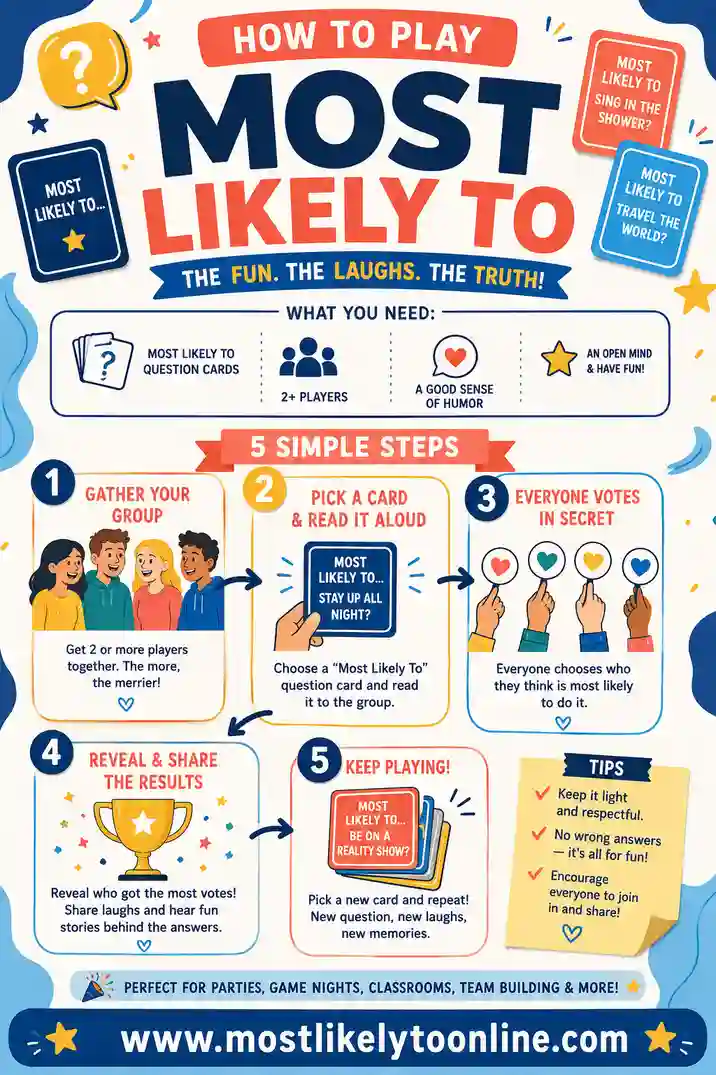
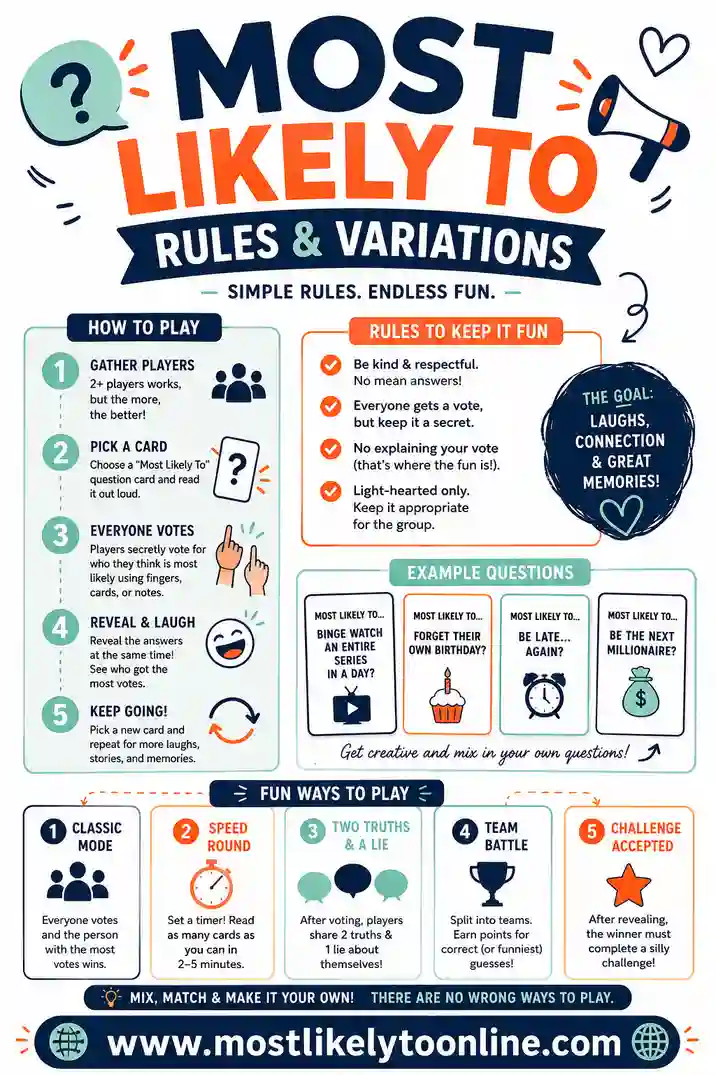
- Get a group together. Two or more players, seated so everyone can see each other.
- Choose a reader. One person reads the prompt aloud. Rotate this each round so it stays fair.
- Read a "Most likely to…" prompt. For example, "Who's most likely to forget the rules halfway through?"
- Vote on three. Everyone points at one person at the same time, counting "one, two, three, point!"
- Name the round winner. The person with the most points takes the round. They get to react, defend, or own it.
- Repeat. Pass the reader role and play as many rounds as you like.
There's no board, no losing, and no required end point. Most groups play until the laughs slow down, usually fifteen to twenty rounds. For a deeper walkthrough, see our full guide on how to play Most Likely To.
Scoring Variations
The classic game is often played with no score at all. But if your group is competitive, here are clean ways to keep points.
Standard scoring
Every time the group picks you as "most likely," you earn one point. Play a set number of rounds, then the highest total wins. Simple and intuitive.
Reverse scoring
Points go to the least picked answer each round. This rewards surprising or sneaky votes and keeps quieter players in the game. The lowest-profile person can quietly rack up a win.
Elimination
The most-picked player each round drops out. The last person standing wins. It's a fun way to add tension, though it works best with seven or more players so it doesn't end too quickly.
First to a target
Set a finish line like "first to five points wins." It gives the game a clear ending and keeps rounds snappy.
| Scoring style | Who wins | Best for |
|---|---|---|
| Standard | Most picks | Competitive groups |
| Reverse | Fewest picks | Mixing up the usual winners |
| Elimination | Last one in | Bigger groups, more drama |
| First to target | First to hit the number | Short, fast game nights |
Team Variations
For large groups, splitting into teams keeps everyone involved and speeds things up.
- Team vote. Each team huddles and agrees on one answer per prompt. If both teams pick the same person, that's a fun match.
- Team about teams. Ask prompts like "Which team is most likely to win the next round?" Lighthearted rivalry, no individuals singled out.
- Relay rounds. Teams take turns reading and answering, racing through a set number of prompts before a timer runs out.
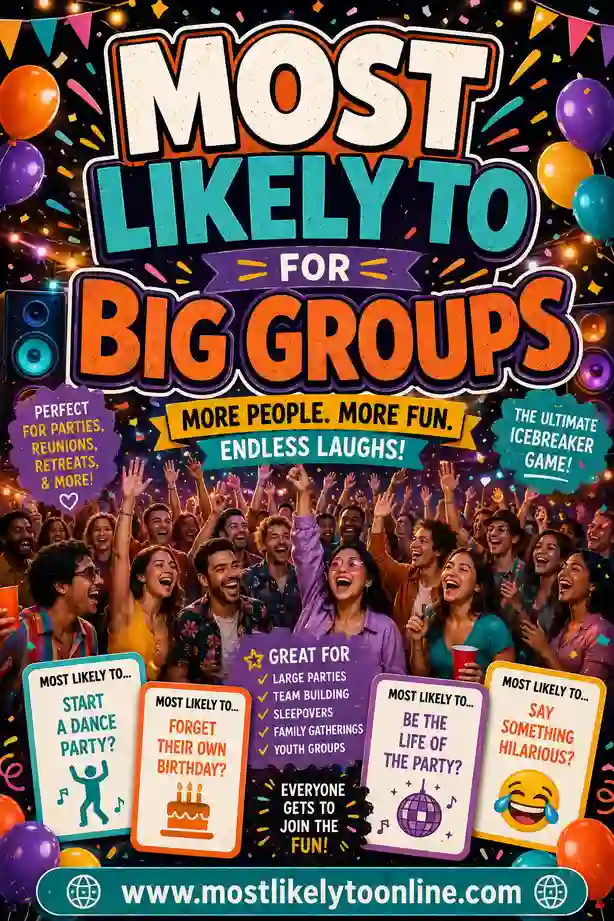
Teams shine at parties, classrooms, and work events where ten-plus people would make individual voting slow. Our big groups guide goes deeper on running a crowd.
Themed Variations
Pick a theme and only ask prompts that fit it. Themes give the game focus and let you tailor the humor to your group.
- Travel and adventure. "Most likely to miss the flight," "most likely to plan the whole itinerary."
- Food. "Most likely to order the weirdest thing on the menu," "most likely to finish everyone's leftovers."
- School. "Most likely to ace the test without studying," "most likely to fall asleep in class."
- Future. "Most likely to become famous," "most likely to invent something."
- Holiday. Swap in seasonal prompts for Christmas, Halloween, or New Year's parties.
You can pull a full themed set from the questions master list, which sorts prompts by crowd and mood.
Hot Seat Variation
This one flips the format and gets personal in the best way.
- One player becomes the "hot seat" and steps back from voting.
- The group answers "Most likely to…" prompts about that one person specifically.
- After a few rounds, the hot-seat player guesses what the group said about them.
It's a sweet, revealing twist that works great for birthdays or sending off a friend. Everyone takes a turn in the seat, so it's fair and inclusive.
Speed and Challenge Variations
When the energy is high, these keep the pace electric.
- Speed round. Set a one-minute timer and answer as many prompts as you can. No debating, just instant votes.
- No-repeat rule. Once a player has been picked, they can't be the answer again until everyone's been chosen at least once. This spreads the spotlight.
- Defend or pass. The picked player gets ten seconds to argue why it's not them. If the group agrees, the vote passes to the runner-up.
- Double points. Mark a few "bonus" prompts worth two points to shake up the scoreboard.
Adult Variations (18+)
For grown-up game nights, a couple of optional twists add stakes. Keep them gentle and always make participation a choice.
- Sip rounds. Whoever gets picked takes a small sip. Pace it slowly and keep water nearby.
- Mini dares. The top pick draws a light, silly dare instead of a sip.
These are optional and best kept easygoing. If your group wants a structured version, our Most Likely To drinking game guide (18+) lays out safe, fun rules.
45 Questions for Any Variation (Copy & Paste)
Pull from this list for classic play, themes, or speed rounds. They're clean and flexible.
- Most likely to win a game show
- Most likely to forget the rules halfway through
- Most likely to become the team captain
- Most likely to start a friendly argument
- Most likely to keep playing past midnight
- Most likely to make up a new rule
- Most likely to win every round
- Most likely to high five a stranger
- Most likely to organize a rematch
- Most likely to laugh instead of answering
- Most likely to keep the best poker face
- Most likely to cheer the loudest
- Most likely to plan the next game night
- Most likely to miss their flight
- Most likely to plan the whole itinerary
- Most likely to order the weirdest thing on the menu
- Most likely to finish everyone's leftovers
- Most likely to ace a test without studying
- Most likely to fall asleep in class
- Most likely to become famous one day
- Most likely to invent something useful
- Most likely to win a dance-off
- Most likely to get the giggles at a bad time
- Most likely to give a surprise gift
- Most likely to remember every detail
- Most likely to lose track of time
- Most likely to make a new friend anywhere
- Most likely to take charge in a crisis
- Most likely to overthink a simple choice
- Most likely to start a spontaneous road trip
- Most likely to win at board games
- Most likely to bring the best snacks
- Most likely to talk to the dog at a party
- Most likely to know a random fun fact
- Most likely to cry at a happy ending
- Most likely to wear matching outfits with a friend
- Most likely to volunteer first
- Most likely to take the most photos
- Most likely to fix anything with tape
- Most likely to sing in the car
- Most likely to win a staring contest
- Most likely to nap through an alarm
- Most likely to keep the group on schedule
- Most likely to laugh at their own joke
- Most likely to suggest one more round
How to Choose the Right Variation
Not sure which version fits your night? Use this quick guide.
| Your group | Try this variation |
|---|---|
| Small and casual | Classic, no score |
| Competitive friends | Standard or first-to-target scoring |
| Big party or class | Team mode |
| Birthday or send-off | Hot seat |
| High energy | Speed round |
| Adults only | Sip or dare rounds |
When in doubt, start classic. You can always layer on a variation once everyone's warmed up.
Frequently Asked Questions
What are the basic rules of Most Likely To?
One person reads a "Most likely to…" prompt, everyone votes for the player who fits it best, and the most-picked person wins the round. Vote at the same time on the count of three to keep it honest. Repeat for as many rounds as you like.
How do you keep score in Most Likely To?
The most common method gives one point to whoever the group picks each round, and the highest total after a set number of rounds wins. You can also reverse it so the least-picked answer scores, or play elimination where the top pick drops out.
Can you play Most Likely To with two people?
Yes, though it changes a little since there are only two possible answers. It works as a "which of us" game, "Which of us is most likely to oversleep?" The free tool handles small groups and can pick for you.
What's the most fun variation?
Hot seat is a crowd favorite because it gets personal and sweet, and speed rounds are great when the energy is high. For big groups, team mode keeps everyone involved. Try a few and see what your group loves.
Do you need any equipment for these variations?
No. Every variation runs on just people and prompts. If you want scoring or random picking handled automatically, the online game does it for free with no setup.
How long does a game of Most Likely To last?
A casual round runs about fifteen to twenty minutes, or ten to twenty prompts. Scored and elimination versions can go longer. The nice thing is you can stop anytime, ideally on a big laugh.
Pick Your Rules and Play
Now you've got every Most Likely To rule and variation in one place, from the classic format to scoring, teams, themes, and twists. Choose the version that fits your crowd, open the free Most Likely To game, and start playing in seconds. It's free, there's no sign-up, and it handles the questions and picking so you can focus on the fun.