Most Likely To vs Never Have I Ever: Which to Play?
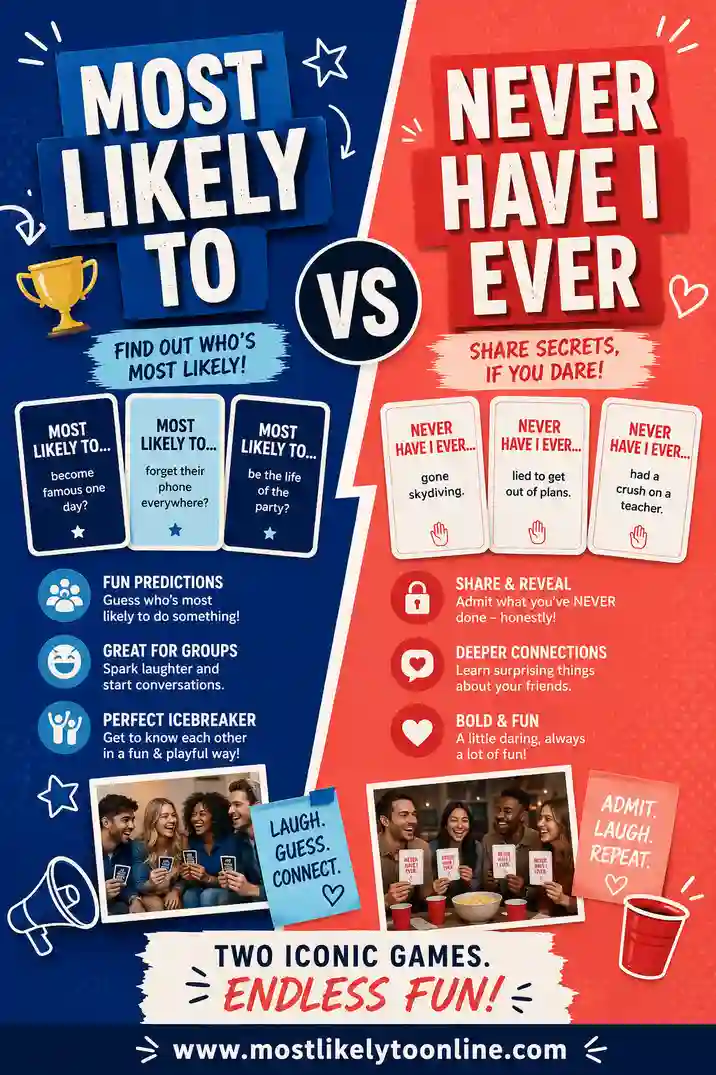
Most Likely To and Never Have I Ever are both no-supplies group games, but they point in opposite directions. Most Likely To is about other people: you read a prompt like "Most likely to sleep through their alarm," and everyone votes on who fits. Never Have I Ever is about you: someone says "Never have I ever skipped class," and anyone who's done it admits it. If you want a fast, laughing, vote-on-your-friends game that works with any age, Most Likely To is the easier pick.
Want to try the friendlier of the two right now? Open the free Most Likely To game, add your friends' names, and it picks who's "most likely" each round. No sign-up, no cards, nothing to download. There's a full breakdown of both games below so you can choose the right one for tonight.
The Quick Answer
Both games are free, need zero equipment, and run on nothing but a group of people. The core difference comes down to who the spotlight lands on.
- Most Likely To points at the group. You guess which friend is "most likely" to do something. It's playful, fast, and stays light because nobody has to confess anything real.
- Never Have I Ever points at the individual. You reveal whether you've personally done a thing. It can get funny, but it can also get personal fast.
If your crowd is mixed ages, includes people who don't know each other well, or you just want easy laughs, go with Most Likely To. If you've got close friends who love trading stories and don't mind oversharing, Never Have I Ever has its charm.
How Most Likely To Works
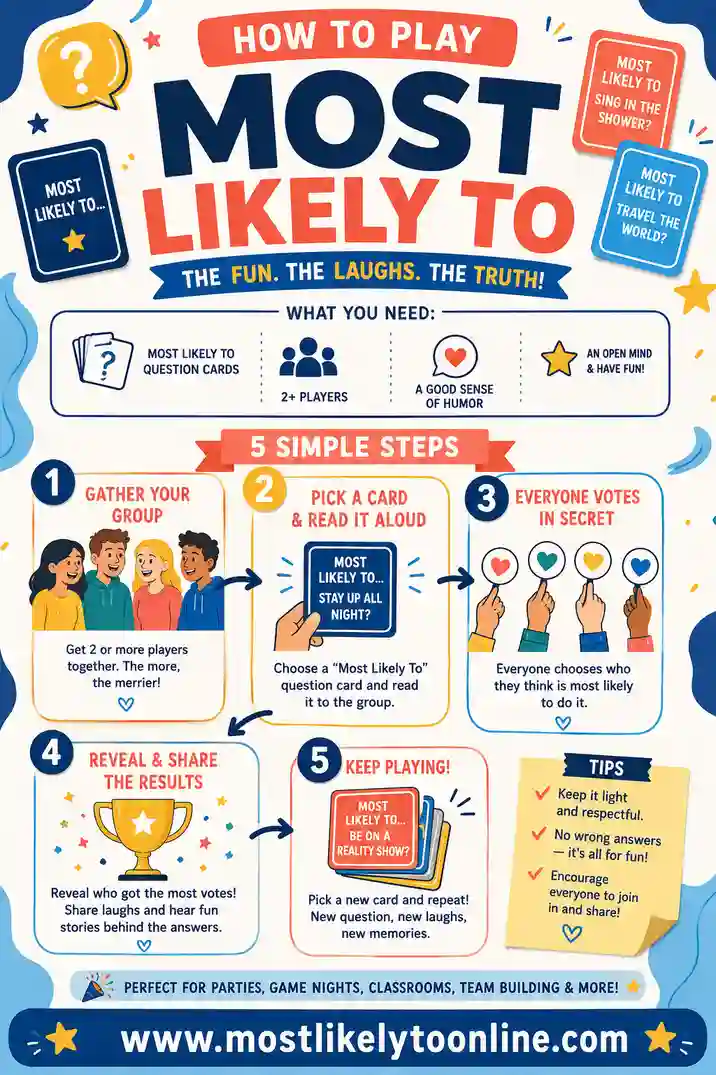
The rules take about ten seconds to explain. Someone reads a prompt that starts with "Most likely to," then everyone points at or names the person they think fits best. Whoever gets the most votes "wins" that round (or loses, depending on the prompt).
A clean game looks like this:
- Gather your group. Three people is enough; ten is a blast.
- Read a prompt. Something like "Most likely to become a millionaire" or "Most likely to trip on flat ground."
- Everyone votes. Point on the count of three, or shout the name.
- The most-named person takes the round. React, laugh, move on.
You can play by reading prompts off a phone, or let a free generator handle the prompts and even pick a random "winner" for you. Because the answers are about other people, it never forces anyone to admit something they'd rather keep private.
How Never Have I Ever Works
Never Have I Ever flips the focus inward. Players take turns making a statement starting with "Never have I ever," and anyone in the group who has done that thing reacts, usually by putting a finger down or owning up.
A typical round:
- Sit in a circle. Everyone holds up ten fingers (the classic version).
- Take turns. Each person says "Never have I ever…" plus something they haven't done.
- Anyone who has done it puts a finger down.
- Last person with fingers up wins (or, in some versions, the first one out has to share a story).
It's a confession game at heart. That's what makes it fun with close friends and what makes it risky with a mixed crowd. A single bold statement can put someone on the spot in a way Most Likely To never does.
Side-by-Side Comparison
Here's the fast version if you're deciding right now.
| Feature | Most Likely To | Never Have I Ever |
|---|---|---|
| Spotlight | On the group ("who would?") | On you ("have I?") |
| Setup | None | None |
| Best group size | 3–12 | 4–10 |
| Vibe | Light, playful, teasing | Personal, revealing |
| Risk of oversharing | Low | Higher |
| Works with mixed ages | Yes, easily | Depends on the prompts |
| Good for new friends | Great icebreaker | Can feel too forward |
| Keeps a "winner" | Yes (most-voted) | Yes (last finger up) |
| Plays on a phone | Yes, with a free tool | Usually read aloud |
Neither game is "better." They're built for different moods. Most Likely To is the one you reach for when you want everyone laughing within a minute. Never Have I Ever is the one for a cozy night with people who already trust each other.
When to Pick Most Likely To
Reach for Most Likely To when the goal is easy fun and nobody's on the hot seat. It shines in these moments:
- Icebreakers. New coworkers, a first hangout, a club's opening night. Voting on lighthearted prompts breaks tension without forcing confessions.
- Mixed ages. Family reunions, classrooms, youth groups. You can keep every prompt squeaky clean and still get big laughs.
- Large groups. Ten or fifteen people all voting at once creates a fun, rowdy energy.
- Long waits. Road trips, lines, layovers. It needs nothing but the people around you.
Because the answers are about other people in a friendly way, it rarely gets awkward. That makes it the safer default for almost any crowd.
When Never Have I Ever Fits Better
Never Have I Ever earns its place too. It's the right call when:
- You're with close friends. People who already swap stories will love the reveals.
- You want deeper conversation. A good "never have I ever" can spark a great tangent.
- The group is tight and small. Four or five close friends keeps it warm instead of exposing.
The catch is control. One pointed statement can turn a fun night tense, so it works best when everyone knows and trusts each other.
You Can Actually Play Both
Here's a secret: you don't have to choose. The two games pair beautifully in one session.
- Warm up with Most Likely To. Use it as the icebreaker. Five or ten light rounds get everyone laughing and comfortable.
- Slide into Never Have I Ever. Once the group's relaxed, the confession game lands softer.
- Bounce back to Most Likely To. If a round gets too personal, switch back to lighten the mood.
Using Most Likely To as the on-ramp is one of the easiest ways to make any group game night work. It does the social heavy lifting so the more revealing game can breathe.
Sample Prompts for Each Game
To see the difference clearly, compare a few prompts side by side. Notice how Most Likely To stays outward-facing and easy, while Never Have I Ever turns personal.
Most Likely To (vote on a friend):
- Most likely to become famous
- Most likely to forget their own birthday
- Most likely to start a food fight
- Most likely to win a dance-off
- Most likely to befriend a celebrity
- Most likely to get lost in their own town
- Most likely to plan the whole vacation
- Most likely to laugh at the worst time
- Most likely to fall asleep at a party
- Most likely to send a text to the wrong person
Never Have I Ever (confess for yourself):
- Never have I ever sung karaoke sober
- Never have I ever been on TV
- Never have I ever stayed up for 24 hours straight
- Never have I ever forgotten someone's name mid-conversation
- Never have I ever cried at a cartoon
See it? The Most Likely To prompts spark guessing and teasing. The Never Have I Ever ones ask you to reveal something. That single shift changes the whole feel of the night.
Which Game Wins for Each Situation
Still deciding? Here's a quick cheat sheet for matching the game to your night.
- First hangout with new people: Most Likely To. The voting is light, so nobody has to confess a thing.
- Close friends, cozy night: Never Have I Ever. The reveals land warmly when there's already trust.
- Family game night: Most Likely To, kept clean. It gets big laughs across every age.
- Classroom or youth group: Most Likely To. It's the easiest to keep age-appropriate.
- Tight-knit small group: Never Have I Ever, with kind, low-stakes statements.
- Big, loud party: Most Likely To. A dozen people voting at once is pure fun.
The honest takeaway is you can't really go wrong. Both are free, both need nothing, and both have entertained groups for years. If you want the one that warms up any crowd fastest and never puts someone on the spot, start with Most Likely To.
Keeping Either Game Clean
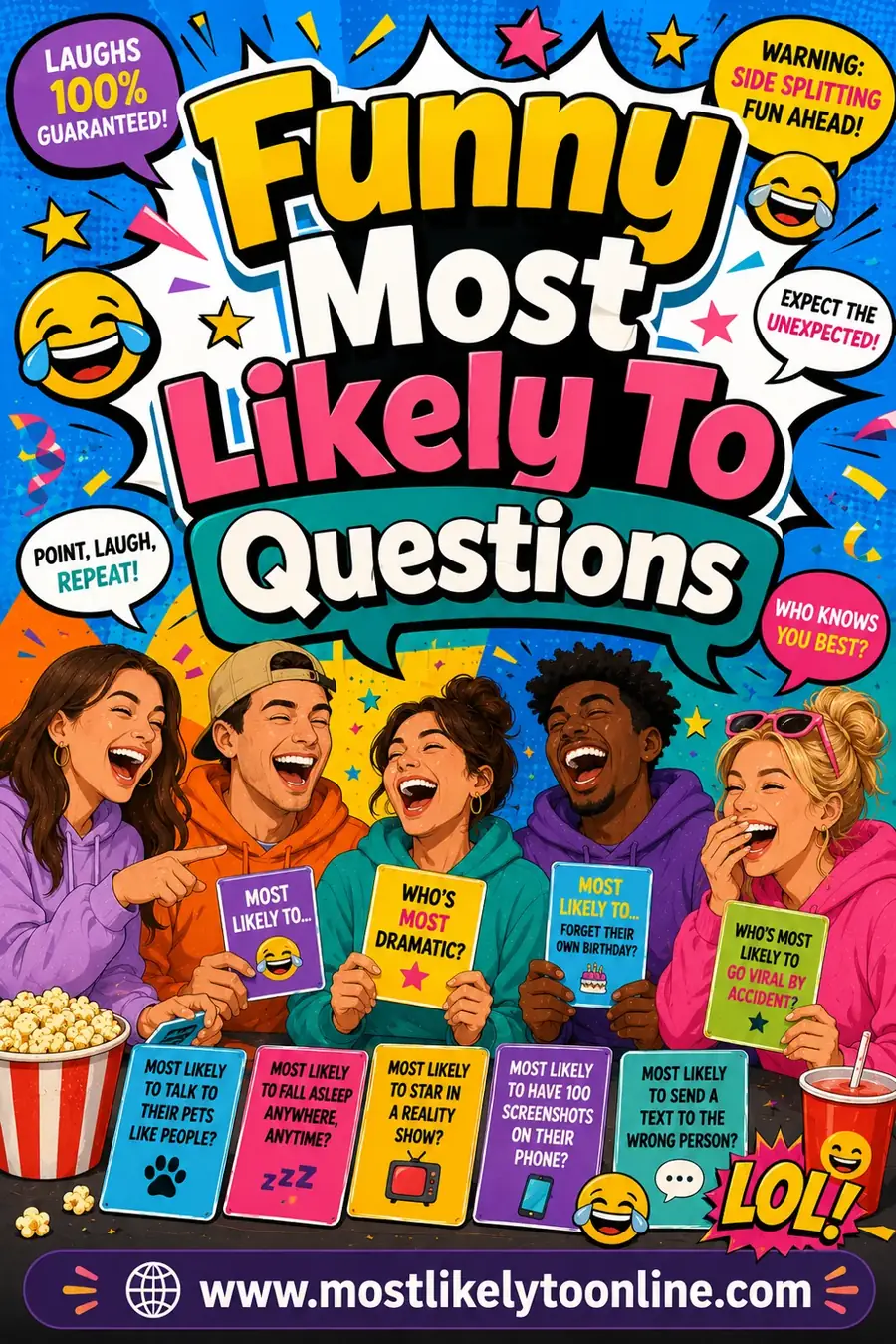
Both games have "spicy" versions floating around online, but you don't need them. A clean prompt list keeps the door open to every group, including families, classrooms, and church youth nights. With Most Likely To it's especially easy, since the prompts never ask for confessions in the first place. If you want ready-made clean material, the funny Most Likely To questions list is all PG and copy-paste ready.
Frequently Asked Questions
Is Most Likely To or Never Have I Ever better for icebreakers?
Most Likely To is the stronger icebreaker. Because you vote on other people in a playful way, nobody has to reveal anything personal, which feels safer with new acquaintances. Never Have I Ever works better once a group already knows each other.
Can kids play Most Likely To and Never Have I Ever?
Kids can play both with clean prompts, but Most Likely To is the easier fit. It never asks for confessions, so you can keep every round age-appropriate. Never Have I Ever needs careful prompt selection to stay kid-friendly.
What do you need to play either game?
Nothing but people. Both games are no-equipment classics. For Most Likely To you can use a free online tool to draw prompts and pick a random winner, while Never Have I Ever is usually just spoken aloud in a circle.
How many people do you need?
Three or more works for Most Likely To, and it scales happily to a dozen. Never Have I Ever plays best with four to ten people so everyone gets turns without it dragging.
Can you combine the two games?
Yes, and it's a great idea. Start with Most Likely To to warm everyone up, then move into Never Have I Ever once the group feels comfortable. Switch back to Most Likely To anytime a round gets too personal.
Which game causes more awkward moments?
Never Have I Ever has a higher chance of an awkward moment because it asks players to admit what they've done. Most Likely To stays light since it's only about guessing, which is why it's the safer default for mixed crowds.
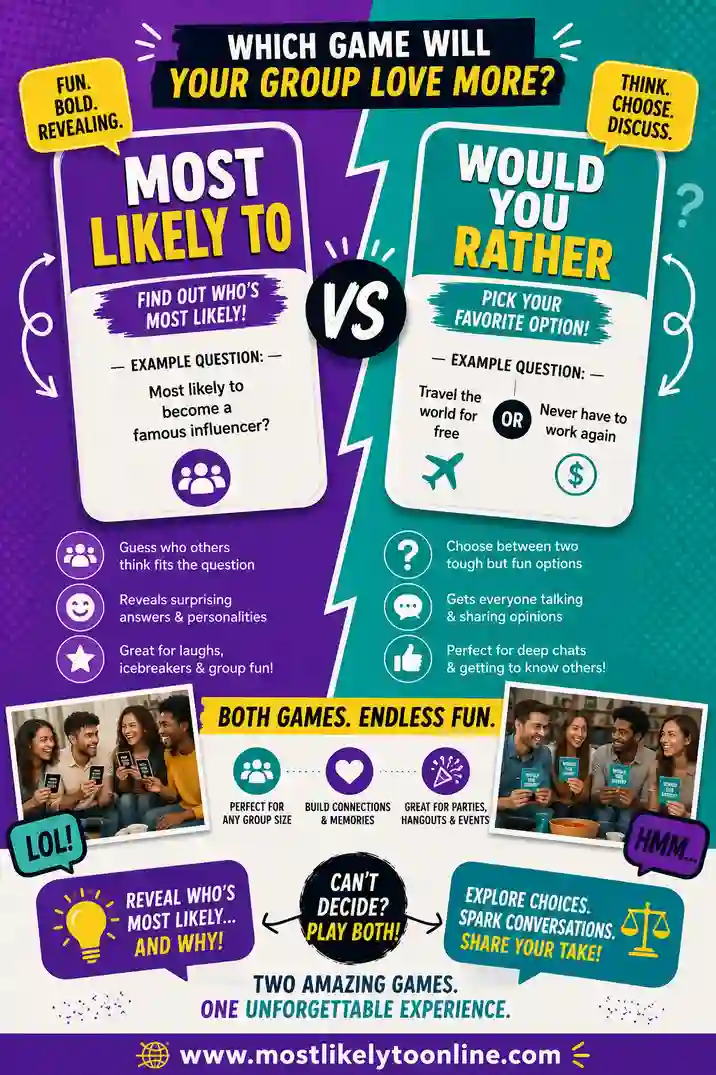
Ready to Play the Easy One?
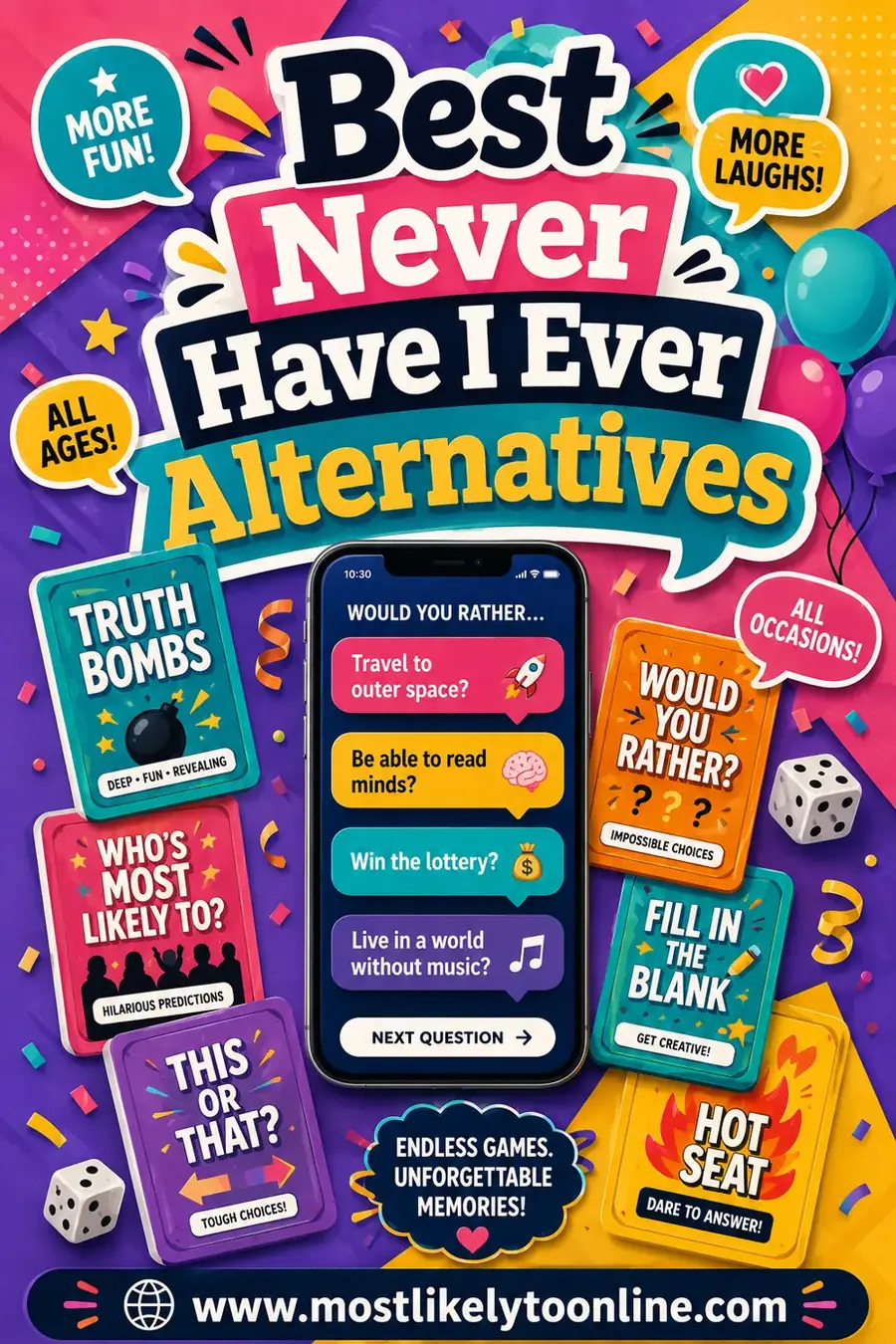
If you want laughs without anyone sweating in the spotlight, Most Likely To is your game. Open the free Most Likely To generator, add your friends' names, and start drawing prompts in seconds. It's free, there's no sign-up, and it works on any phone. Want to weigh another matchup? See Most Likely To vs Would You Rather, brush up with how to play Most Likely To, or browse the best Never Have I Ever alternatives.