Most Likely To Party Host Guide: Run a Game Everyone Loves
To host a great Most Likely To party game, set up a list of fun prompts, gather your guests in a circle, read each "Most likely to…" question with energy, and let people vote by pointing on the count of three. Keep rounds short, mix gentle questions with bold ones, and stop while the laughs are still flowing. This guide walks you through every step, from prep to the final round.
Want the easiest possible setup? Open the free Most Likely To game, type in your guests' names, and it reads the questions and picks winners for you, so you can host without juggling a list or counting points.
Why Most Likely To Is a Perfect Party Game
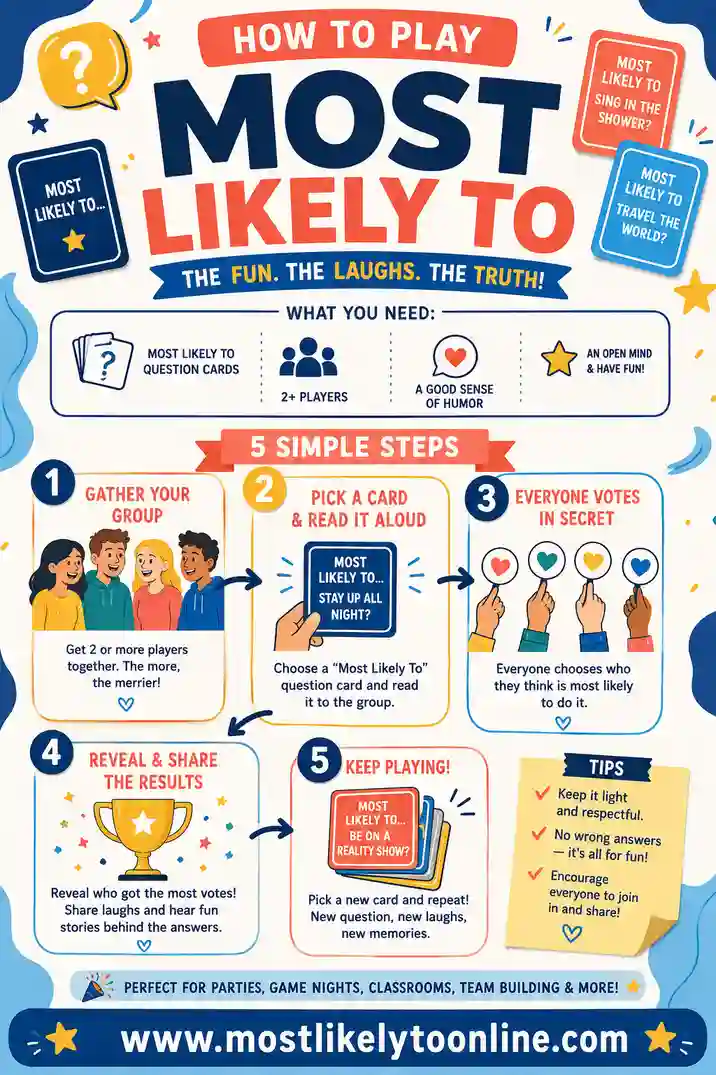
Most Likely To earns its spot at parties because it asks almost nothing of you and gives back a lot. There's no board to set up, no rules to teach, and no equipment to buy. You can launch it in thirty seconds, and it instantly turns a quiet room into a laughing one.
It also scales. Five people or twenty-five, the game flexes to fit. And because every question is about the guests themselves, it pulls in even the shy ones. People who'd never volunteer for charades happily point at a friend and laugh along.
As the host, your job is simple: keep the energy up and the rounds moving. The rest takes care of itself.
Before the Party: Your Host Prep Checklist
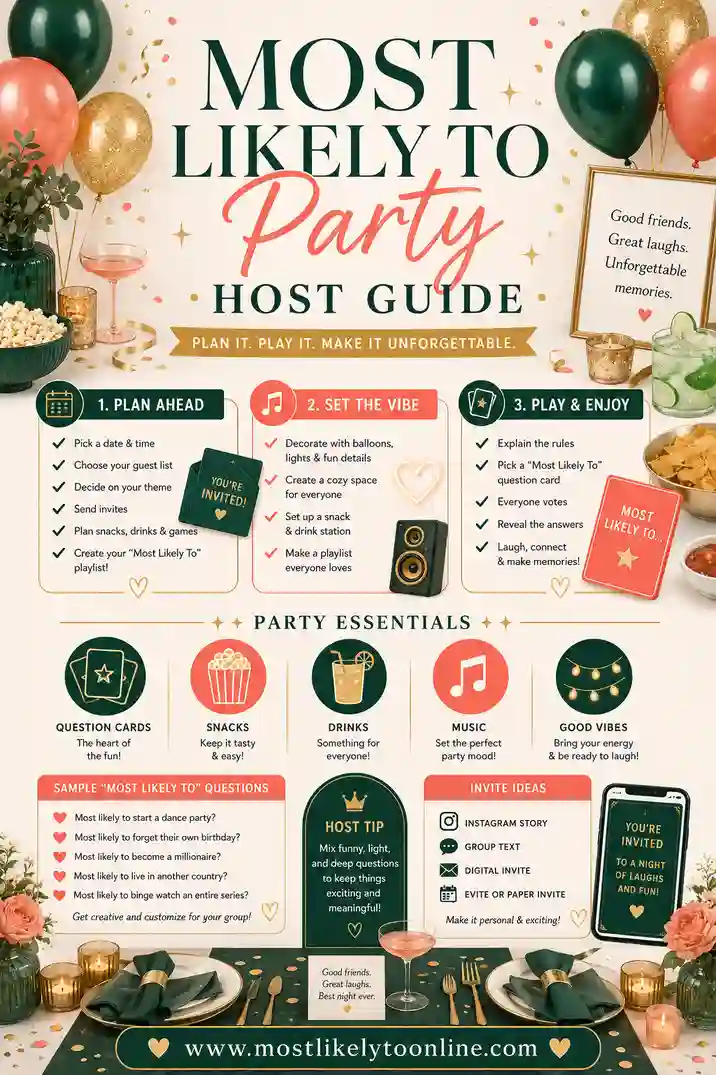
A little prep makes hosting feel effortless. Here's what to handle ahead of time.
- Pick your questions. Grab a list of prompts that match your crowd. There's a 45-question list below, or load the free game for hundreds.
- Decide on scoring. Casual no-score is easiest. If your group is competitive, plan a simple "first to five" or running tally.
- Plan the timing. Slot the game in after guests have arrived and mingled a bit, when energy is high but before people get tired.
- Prep a vibe. Lower background music a notch so prompts are easy to hear. Clear a space where everyone can see each other.
- Have a phone ready. If you're using the online tool, make sure it's charged and the screen is bright.
That's the entire prep. No printing, no props, no rehearsal.
Setting Up the Game
When you're ready to start, here's the quick setup.
- Gather everyone. A circle or loose semicircle works best so all faces are visible.
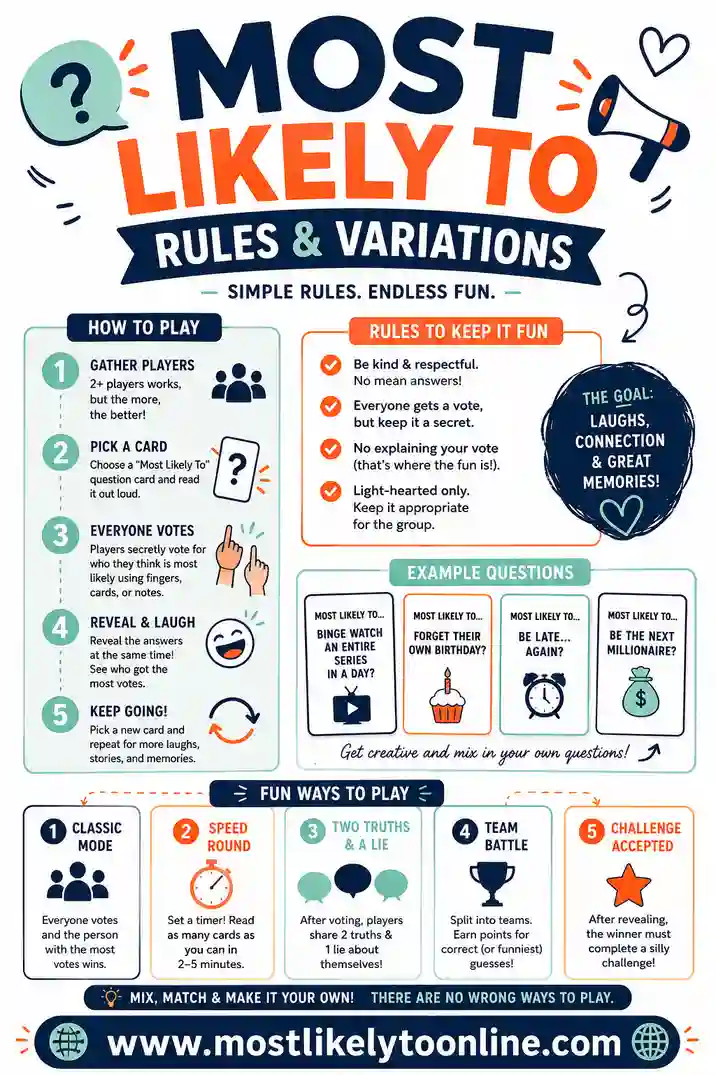
- Explain the game in one sentence. "I read a 'Most likely to' question, and we all point at the person who fits it best."
- Set the voting method. Pointing on the count of three for in-person, hands-up for big groups or video calls.
- Do a practice round. Run one easy prompt so everyone gets the rhythm before it counts.
Keep the intro short. The faster you get to the first real round, the faster the laughs start.
Reading Prompts Like a Pro Host
The single biggest factor in how fun the game feels is how you read the questions. A flat read kills the energy. Here's how the best hosts do it.
- Read with a smile. Your tone sets the room's tone. Sound like you're in on the joke.
- Pause after the prompt. Give a beat for people to scan the room before the count.
- Count clearly. "One… two… three… point!" so everyone votes together.
- React to the result. Call out the winner playfully: "Wow, unanimous, no contest!"
- Let people defend. The protests are gold. Give the picked person a few seconds to plead their case.
Keep it kind
The best host keeps every round aimed at funny, not cruel. If a prompt feels like it might sting a particular guest, skip it. The goal is for the person picked to laugh along, not feel singled out.
Timing: How Long Should the Game Run?
One of the most common host mistakes is letting the game run too long. Here's a reliable rhythm.
| Group size | Suggested rounds | Rough time |
|---|---|---|
| 4–6 people | 12–15 rounds | 15 minutes |
| 7–12 people | 15–20 rounds | 20–25 minutes |
| 13+ people | 20+ rounds, teams | 25–30 minutes |
The golden rule: stop while it's still fun. End on a big laugh rather than playing until people drift toward their phones. You can always run a second session later in the night.
Handling Big Groups
Once you're past a dozen guests, a few tweaks keep things smooth.
- Switch to hands-up voting. Pointing gets chaotic in a crowd. Read a name and have people raise a hand to agree.
- Use teams. Split into two or three groups and have each agree on one answer per prompt.
- Speed up. Skip long debates. Quick vote, quick laugh, next prompt.
- Stand if you can. A standing circle reads better than a sprawled-out seated crowd.
Our big groups guide covers crowd play in detail, and the rules and variations guide has team formats you can borrow.
45 Party Host Questions (Copy & Paste)
Here's a host-ready list with a party flavor. Copy the whole thing or pick your favorites.
- Most likely to be the life of the party
- Most likely to arrive fashionably late
- Most likely to bring the best snacks
- Most likely to start the dance floor
- Most likely to take the group photo
- Most likely to tell the funniest story
- Most likely to plan the whole event
- Most likely to lose track of time having fun
- Most likely to make a toast on the spot
- Most likely to befriend everyone in the room
- Most likely to stay and help clean up
- Most likely to suggest one more round
- Most likely to wear the boldest outfit
- Most likely to hug everyone goodbye
- Most likely to get the crowd singing
- Most likely to remember everyone's name
- Most likely to spill their drink laughing
- Most likely to know the best playlist
- Most likely to organize a group game
- Most likely to be first on the dance floor
- Most likely to take the most photos
- Most likely to fall asleep on the couch
- Most likely to start a conga line
- Most likely to bring an uninvited but welcome friend
- Most likely to win the costume contest
- Most likely to lose their phone at the party
- Most likely to give the best gift
- Most likely to talk to everyone at least once
- Most likely to sneak seconds of dessert
- Most likely to suggest karaoke
- Most likely to be the last one to leave
- Most likely to laugh the loudest
- Most likely to start a deep conversation
- Most likely to challenge someone to a dance-off
- Most likely to bring board games just in case
- Most likely to take charge of the music
- Most likely to make a new best friend
- Most likely to wear something comfy over stylish
- Most likely to remember the night in detail
- Most likely to send the group photos the next day
- Most likely to plan the next party already
- Most likely to befriend the host's pet
- Most likely to lead the toast
- Most likely to cheer the loudest
- Most likely to say "just five more minutes"
For a birthday-specific set, see our birthday party guide, and the master list of how-to basics covers the core rules if anyone needs a refresher.
Host Mistakes to Avoid
A handful of slip-ups can flatten the fun. Steer clear of these.
- Reading flatly. Energy is contagious. Bring it.
- Letting rounds drag. Cut debates short and keep the pace brisk.
- Aiming prompts at one person. Spread the spotlight so nobody feels picked on.
- Playing too long. Stop before the energy fades, not after.
- Forgetting quiet guests. Toss in prompts that suit them so they get a moment too.
Extra Touches That Make You a Memorable Host
Want to go beyond the basics? These small touches earn big reactions.
- Tiny prizes. A candy bar or silly trophy for the most-picked player adds stakes without pressure.
- A "hot seat" round. Put one guest in the spotlight and have the group answer prompts about just them, perfect for a guest of honor.
- Inside jokes. Slip in a few prompts that only your circle would get. These always land hardest.
- A photo moment. Snap a group shot mid-laugh. It captures the night better than a posed picture.
Frequently Asked Questions
How do I host a Most Likely To game at a party?
Pick a list of prompts, gather guests in a circle, and read each "Most likely to…" question aloud. Have everyone vote by pointing on the count of three, then react to the winner. Keep rounds short and stop while it's still fun. The free tool can run it all for you.
When is the best time to play during a party?
Play after guests have arrived and mingled a bit, when energy is high but before people get tired. It works well as an icebreaker early on or as a pick-me-up if the party lulls. Avoid starting it right as people are heading out.
How many questions should a host prepare?
Plan for fifteen to twenty prompts for most parties, which runs about twenty minutes. Have extras ready in case the group wants more. The online game never runs out, so you don't have to count.
What if some guests are shy?
Most Likely To is naturally shy-friendly because people vote by pointing rather than performing. Include gentle, positive prompts so quieter guests get picked for sweet reasons, and never force anyone to defend a vote.
How do I handle a really big group?
Switch from pointing to hands-up voting, or split into teams that each agree on one answer per prompt. Keep the pace fast and skip long debates. Our big groups guide has more crowd-friendly tips.
Should I keep score?
Only if your group likes competition. Casual no-score play is easiest and keeps the focus on laughs. If you do score, a simple "first to five points" gives the game a clean finish.
Host Your Best Game Night
You're set to host a Most Likely To party that gets the whole room laughing. Prep a few prompts, read them with energy, keep the rounds moving, and stop on a high note. For the easiest setup of all, open the free Most Likely To game, add your guests' names, and let it run the show. It's free, there's no sign-up, and you'll look like a pro host in seconds.