
Most Likely To for a White Elephant or Secret Santa Swap: Fill the Wait Between Turns
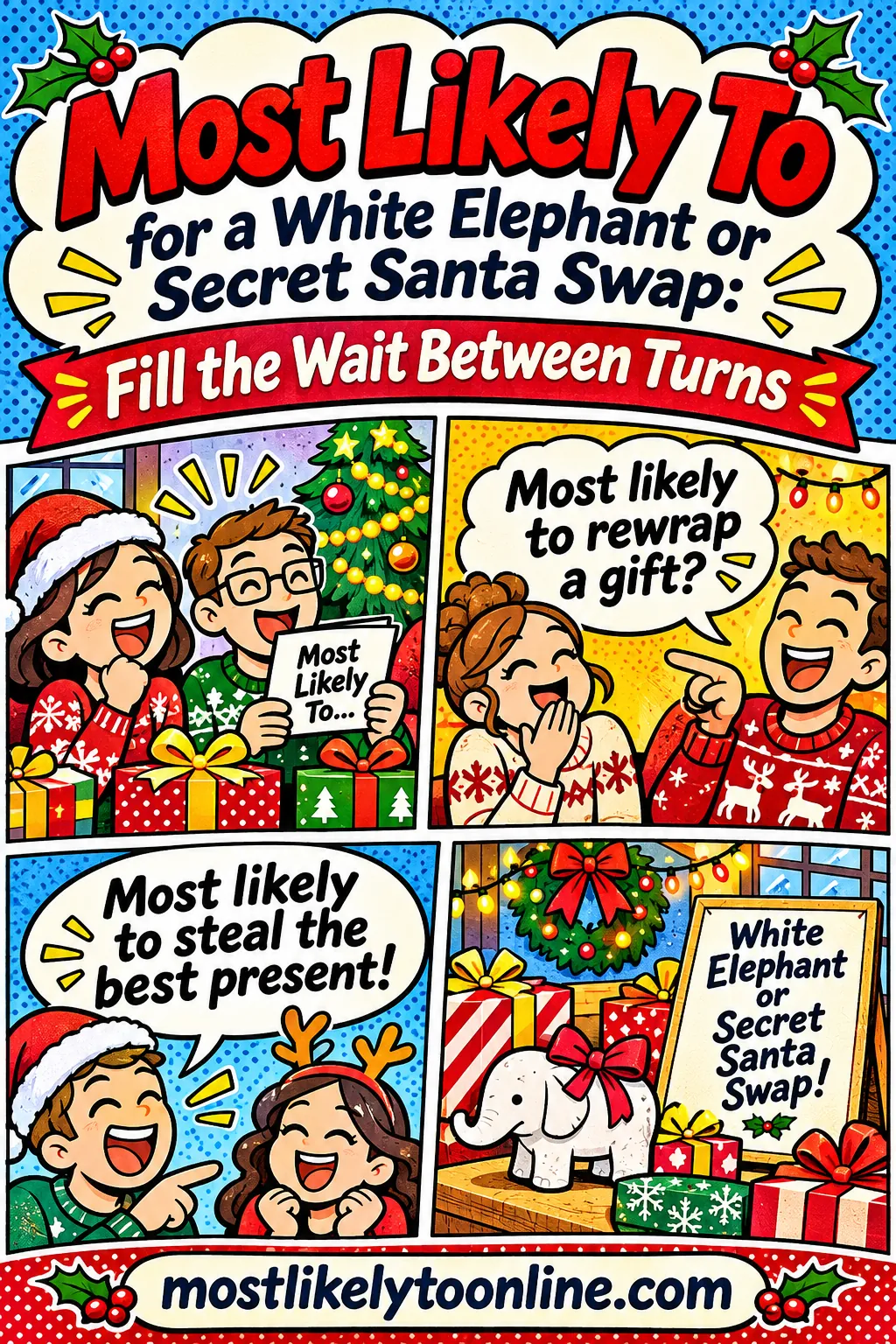
The simplest white elephant party games run in the gaps of the swap itself: while the next person walks to the gift pile, put one "most likely to" prompt on a screen, count to three, and everyone points at once. Nobody needs supplies, nobody leaves their seat, and the round is over before the next gift is unwrapped, so the swap keeps its pace and the people waiting finally have something to do.
The free Most Likely To game handles the prompts for you. It has a Christmas category, a Clean setting for mixed ages, a big-screen mode for the TV and an optional countdown timer. Below you'll find exact settings, more than 50 swap-themed prompts, a turn-by-turn timeline for groups of 10 to 40, host scripts and fixes for the moments that usually stall a gift exchange.
🎯 Play a round with this list
Read it out, then everyone points at who fits on the count of three.
Why the Wait Between Turns Feels So Long
A white elephant or Secret Santa swap sounds like a party game, but for most guests it's mostly waiting. Here's why.
In a standard white elephant, each person takes a turn to either unwrap a new gift from the pile or steal one that's already been opened. Only one person acts at a time. Everyone else watches.
Do the math for your own party. If a turn takes about a minute or two, counting the walk to the pile, the unwrapping, the reaction and any steal, then:
- 10 guests means roughly 10 to 20 minutes of turns.
- 20 guests means roughly 20 to 40 minutes.
- 30 guests means roughly 30 to 60 minutes.
- 40 guests can run well past an hour, especially with lots of steals.
The first few turns are fun because everything is new. By turn 15, the people who already went are sitting with their gift on their lap, the people near the end are checking phones, and side conversations start drowning out the unwrapping. In an office or a big family gathering, that's when someone says "Can we speed this up?" and the host feels pressure to rush.
What hosts actually need
The fix isn't another big game that stops the swap. A full round of charades or trivia in the middle of a gift exchange breaks the flow and stretches the evening. What works is a tiny activity that:
- Takes 10 to 20 seconds. It has to fit into the time it takes one person to walk up and pick a gift.
- Needs no supplies. No paper, no pens, no cards to deal.
- Involves everyone at once. Every guest, including the person at the pile, can take part.
- Ends cleanly. When the gift is ready to open, the room's attention snaps back to the swap.
- Stays friendly. Coworkers, in-laws, kids and new neighbors can all play without anyone feeling put on the spot.
Most Likely To fits that list almost perfectly. You read a prompt, everyone points at the person who fits it best, there's a laugh, and you're done.
How It Works: One Prompt Between Each Turn
The idea is simple: the swap stays the main event, and Most Likely To fills only the dead air.
The basic loop
- The current player finishes their turn. They've unwrapped or stolen, and the room has reacted.
- The host taps Next. A new prompt appears on the TV, a laptop or a phone held up for the room.
- The host reads it out loud. "Who is most likely to steal the gift they secretly wanted all along?"
- Everyone counts to three and points. All at once, no discussion first.
- The person with the most fingers on them gets a laugh or a cheer. That's it. No points needed.
- The next player is already walking to the pile. By the time they've picked a gift, the prompt round is over.
The key is timing. You aren't stopping the swap for a game. You're playing the game while the swap moves physically from one person to the next.
Why pointing works better than talking
Pointing keeps it quick. Everyone answers at the same instant, so there's no waiting for opinions and no long debates. It also keeps quieter guests included, because pointing takes zero confidence. And the person at the gift pile can join in too: they just point from where they're standing.
If your group loves to debate, you can still allow a five-second "defend yourself" from whoever got picked, but cap it there. The next gift is waiting.
Where to show the prompts
| Setup | Best for | How to do it |
|---|---|---|
| TV or projector | Living rooms, offices, community halls | Open the game on a laptop connected to the screen and tap Big screen |
| Laptop on a table | 8 to 15 people in a circle | Turn the laptop toward the group and use Big screen |
| One phone, read aloud | Small groups, or when there's no screen | The host reads each prompt; nobody needs to see it |
| Printed cards in a bowl | No devices allowed, or a church or school hall with no TV | Print a set in advance and draw one per turn |
Any of these works. The TV version gets the most reactions because everyone can read the prompt, but reading aloud from a phone is perfectly fine for a family room.
How to Set Up the Free Most Likely To Game for a Gift Swap
You can set this up in about two minutes before guests arrive. Open the Most Likely To game on the device you'll use during the swap and follow these steps.
Step 1: Pick the Christmas category
Along the top you'll see category buttons. Tap 🎄 Christmas. This category is full of holiday prompts like "most likely to shake the presents to guess what's inside" and "most likely to wrap gifts in the messiest way possible," which fit a gift swap naturally.
If your swap isn't Christmas-themed, or you want variety, the 🎉 Party, 👪 Family and 💼 Office categories also work well.
Step 2: Set Content to Clean
Next to "Content," tap Clean. It's the default, and it filters the questions down to family-friendly prompts. For an office swap, a church group, a school staff party or any gathering with kids, keep it on Clean. Don't switch to Bold unless you know your group well.
Step 3: Turn on Big screen
Tap 📺 Big screen to blow the question card up to fill the display. On a TV across the room, that's what makes the prompt readable from the couch. Press Escape to leave big-screen mode when you're done.
Step 4: Decide on the timer
Near the Next button there's a Timer row with off, 15s, 30s and 60s. For a gift swap, try 15s. Every time you tap Next, the countdown restarts, and it's a nice visual cue that this round is short. The timer just counts down to zero; it won't skip to the next prompt by itself, so you stay in control of the pace.
If your group gets restless with a clock on screen, leave it off.
Step 5: Skip Add players for big groups
The Add players switch lets you type everyone's names so the game randomly picks a "winner" for each prompt. That's great for 6 to 12 people who want a quick verdict with no arguing. For a swap of 20 or more, it's usually easier to leave it off, because typing everyone's names takes time and the pointing is the fun part.
The Vote button, which appears once three or more players are added, runs a pass-the-phone secret ballot. It's fun on a game night, but in a gift swap it would slow things down. Skip it for this format.
Step 6: Use Next and Back as you go
During the swap, tap Next Question → each time a new player heads to the pile. On a laptop, the space bar or right arrow key does the same thing, which is handy if you're across the room with a wireless keyboard. If you skip a prompt by accident, tap ◀ Back.
Quick settings summary
| Setting | Choose | Why |
|---|---|---|
| Category | 🎄 Christmas | Holiday prompts that match a gift swap |
| Content | Clean | Safe for coworkers, kids and relatives |
| Display | 📺 Big screen | Readable from across the room |
| Timer | 15s (or off) | Signals that each round is short |
| Add players | Off for 20+ guests, on for small groups | Saves setup time in a big group |
| Vote | Don't use | Pass-the-phone ballots slow the swap |
Step 7: Load your own swap prompts (optional)
The Christmas category is about the holidays in general. If you'd like prompts about the swap itself, such as stealing, wrapping and regifting, add them as your own set:
- Tap ✏️ My Questions at the end of the category list.
- In the text box, type one prompt per line. Each line finishes the phrase "Most likely to…", so write "steal the gift they secretly wanted all along," not the whole question.
- Tap Save. Your lines become their own category, saved in that browser.
- Tap Copy / Export if you want a backup, or to send the list to a co-host so they can paste it into their own device.
Twenty or thirty custom lines covers most swaps. You can pull them straight from the prompt lists below.
Step 8: Print a backup set
Wi-Fi drops, laptops die, and some venues have no screen at all. Tap 🖨️ Print cards, choose Cut-out cards or Checklist sheet, pick 12, 24 or 36 questions, and tap Print. The cards come from whatever category you're on, including My Questions, so set up your custom list first if you want swap-specific cards.
Cut-out cards in a bowl make a nice low-tech version: the person whose turn just ended draws the next card and reads it while the next player walks up.
54 Most Likely To Prompts for a Gift Swap
Here are prompts written specifically for white elephant and Secret Santa swaps. They're all family-safe and work for coworkers, relatives and friends. Read them as written, or drop the "Who is" and paste the rest into My Questions.
About the swap itself
- Who is most likely to steal the gift they secretly wanted all along?
- Who is most likely to bring the gift everyone fights over?
- Who is most likely to shake every box before choosing?
- Who is most likely to pick the biggest box every time?
- Who is most likely to plan their steal three turns ahead?
- Who is most likely to cheer the loudest when their gift gets stolen?
- Who is most likely to forget whose turn it is?
- Who is most likely to trade their gift away in the parking lot?
- Who is most likely to pretend they don't want a gift so nobody steals it?
- Who is most likely to hide their gift behind their back?
- Who is most likely to steal from their best friend without a second thought?
- Who is most likely to feel bad about stealing and try to give it back?
- Who is most likely to go home with the gift they brought?
- Who is most likely to know the rules better than the host?
Wrapping and gift-giving
- Who is most likely to wrap their gift in a cereal box?
- Who is most likely to use way too much tape?
- Who is most likely to wrap a tiny gift in a giant box?
- Who is most likely to use a gift bag and call it wrapped?
- Who is most likely to keep the wrapping paper to reuse?
- Who is most likely to wrap their gift on the drive over?
- Who is most likely to put a bow on everything?
- Who is most likely to give a gift that's secretly really useful?
- Who is most likely to give a heartfelt speech about a candle?
- Who is most likely to regift something from last year?
- Who is most likely to bring a gift they made themselves?
- Who is most likely to be happiest with the gag gift?
- Who is most likely to wear their gift for the rest of the party?
Holiday habits
- Who is most likely to finish holiday shopping the night before?
- Who is most likely to have their shopping done by Halloween?
- Who is most likely to put up decorations before Thanksgiving?
- Who is most likely to leave the lights up until spring?
- Who is most likely to bake enough cookies for the whole block?
- Who is most likely to wear a festive sweater to every holiday event?
- Who is most likely to hum carols all December?
- Who is most likely to eat the last cookie and blame someone else?
- Who is most likely to fall asleep on the couch after the holiday meal?
- Who is most likely to send holiday cards in January?
- Who is most likely to build the best snowman?
- Who is most likely to cry over a sweet holiday commercial?
Office and team swaps
- Who is most likely to bring a gift that's really for the whole office?
- Who is most likely to schedule a meeting about the gift swap?
- Who is most likely to decorate their desk for every holiday?
- Who is most likely to bring homemade treats to the break room?
- Who is most likely to answer email during the swap?
- Who is most likely to remember everyone's birthday?
- Who is most likely to win the office cookie contest?
- Who is most likely to stay late to help clean up after the party?
Family swaps and mixed ages
- Who is most likely to steal a gift from a kid and give it right back?
- Who is most likely to let the youngest player pick first?
- Who is most likely to sneak a peek at the gifts before the swap starts?
- Who is most likely to fall asleep before the swap is over?
- Who is most likely to get the whole family to sing a carol?
- Who is most likely to start a snowball fight after the swap?
- Who is most likely to tell the same holiday story every year?
For more holiday prompts that aren't about the swap, our Christmas edition of Most Likely To has a full list you can mix in.
Matching prompts to swap moments
You'll get more laughs if you match the prompt to what just happened. Keep a few favorites ready for these moments:
| Swap moment | Prompt to read | Why it works |
|---|---|---|
| Someone walks straight to the biggest box | "Who is most likely to pick the biggest box every time?" | Everyone points at them as they're doing it |
| A gift gets stolen | "Who is most likely to cheer the loudest when their gift gets stolen?" | Turns a little sting into a laugh |
| A slow, tape-heavy unwrap | "Who is most likely to use way too much tape?" | Gives the room something to do while they unwrap |
| A silly or gag gift appears | "Who is most likely to be happiest with the gag gift?" | Celebrates the joke instead of the letdown |
| A really nice gift appears | "Who is most likely to plan their steal three turns ahead?" | Builds suspense for the next turns |
| The line stalls | "Who is most likely to forget whose turn it is?" | Pokes fun at the pause and gets things moving |
| Final turn | "Who is most likely to trade their gift away in the parking lot?" | Sends everyone off laughing |
Pacing: A Turn-by-Turn Plan for 10, 20 and 40 Guests
The whole point is to keep the swap moving. Here's how to fit prompts in without stretching the party.
The 15-second rule
Each prompt round should take about as long as it takes one person to get from their seat to the gift pile and choose a gift. In most rooms that's 10 to 20 seconds. If a round runs longer than that, the next player is just standing at the pile waiting, and the swap slows down.
A quick way to stay on time: tap Next the moment the room finishes reacting to the last gift, read the prompt, count to three, point, laugh, and turn back to the pile.
Plans by group size
| Group size | Prompts per turn | Total prompts you'll use | Extra tips |
|---|---|---|---|
| 8 to 12 guests | One every turn | About 10 to 15 | Turn on Add players for an instant verdict if the group is shy |
| 13 to 20 guests | One every turn | About 15 to 25 | Read aloud and use Big screen if you have a TV |
| 21 to 30 guests | One every turn, skip during long steal chains | About 20 to 30 | Name a co-host to run the screen so the swap host can focus on turns |
| 31 to 40 guests | One every other turn, plus every steal | About 20 to 35 | Use the 15s timer to keep rounds short |
| 40+ guests | Only between steals and slow unwraps | As needed | Consider splitting into two swap circles, each with its own screen |
A sample timeline for a 20-person office swap
| Time | What happens |
|---|---|
| 0:00 | Host explains the swap rules and the "point on three" game in under two minutes |
| 0:02 | Turn 1: first player unwraps. Host reads the first prompt while they walk up |
| 0:05 | Turns 2 to 5: one prompt per turn. Steals start around now |
| 0:12 | Turns 6 to 12: match prompts to steals and big reveals |
| 0:25 | Turns 13 to 19: energy dips, so pick the funniest swap prompts here |
| 0:35 | Turn 20 and the final steal-back: read the parking lot prompt |
| 0:40 | Swap ends. Optional: two or three bonus rounds while people gather their things |
The prompts shouldn't add time to the swap. If you find the timeline stretching, read prompts only on every other turn.
Host Scripts: What to Say and When
A few prepared lines make the whole thing feel natural instead of awkward. Feel free to read these word for word.
Explaining the game at the start
"Before we start the swap, one quick thing. Between turns, a question will pop up on the screen, like 'Who is most likely to shake every box?' When I count to three, everybody point at the person you think fits. No talking first, just point. Then we go right back to the gifts. That's it!"
Keep the explanation under 30 seconds. People learn it fastest by doing the first round.
The first round
"Let's try one while Jordan heads to the pile. Who is most likely to pick the biggest box every time? One, two, three!"
Choosing a prompt that matches what the first player is doing gets a laugh right away and shows everyone how the game works.
Between regular turns
"While Priya picks, here's the next one. Who is most likely to wrap their gift on the drive over? One, two, three!"
Say the name of the next player first. It reminds everyone whose turn it is and keeps the swap moving.
Right after a steal
"Ooh, a steal! Okay, while Sam figures out what to do next: who is most likely to cheer the loudest when their gift gets stolen? One, two, three!"
Steals are where tension can build, especially in a family swap with kids. A lighthearted prompt right afterward softens the moment.
When the energy dips
"We're past halfway, so here's a good one. Who is most likely to plan their steal three turns ahead? Be honest. One, two, three!"
Midway through a big swap is when attention drifts. A prompt about strategy pulls everyone back into the game.
When someone gets picked a lot
"Wow, Grandpa Lou has been picked three times in a row. Lou, you get a ten-second defense!"
Giving the most-picked person a quick chance to defend themselves adds fun without slowing the swap, as long as you keep it to a few seconds.
Wrapping up
"That's the last gift! One final question before everyone grabs their things: who is most likely to trade their gift away in the parking lot? One, two, three! Happy holidays, everyone."
Ending on a prompt gives the swap a clear finish line, which matters in an office where people want to get back to work.
Variations for Different Groups
The basic loop works almost anywhere, but a few tweaks help it fit different crowds.
Office and team swaps
Keep Content on Clean and stick to the Christmas, Office or your own swap prompts. Avoid anything about appearance, money, age or someone's personal life. A good office prompt teases a habit everyone shares, like answering email at the party or decorating a desk.
If some coworkers don't celebrate Christmas, use My Questions with winter and swap prompts only, such as wrapping, stealing, snow and cookies, and call it a "holiday swap" or "winter swap." For more ideas on keeping a work party friendly and quick, see our roundup of the best games for office parties.
Family swaps with kids
Kids love pointing games, so this works well with ages six and up. A few tips:
- Let a child be the "prompt reader" for a few turns. They'll love the job and it keeps them busy while they wait.
- Choose prompts about grown-ups too, so kids get to point at Grandma and Uncle Ray, not just each other.
- If a younger child gets upset when their gift is stolen, follow the steal with a prompt that celebrates them, like "Who is most likely to give the best hugs?" You can add that one to My Questions ahead of time.
- Keep the timer off. Countdowns can make little ones anxious.
Church, school and community groups
Big groups in a hall often have no TV. Print 36 cut-out cards in advance, put them in a festive bowl, and let each player draw a card for the next person's turn. That way the whole room shares the job and no one has to run a device. The Clean setting is the right choice here.
Secret Santa reveals
A Secret Santa exchange doesn't have steals, but it has its own waiting problem: one gift is opened at a time while everyone watches and guesses who gave it. A prompt between each opening works the same way. Try ones like:
- Who is most likely to have figured out their Secret Santa already?
- Who is most likely to drop hints about their gift all month?
- Who is most likely to give the most thoughtful gift?
- Who is most likely to forget who they drew?
If your group guesses the giver after each gift, read the prompt first, then the guessing, then the reveal. It keeps the rhythm.
Large swaps of 30 or more
A swap this big benefits from a co-host. One person runs the turns and the gift pile; the other runs the screen and reads prompts. That split keeps either job from slowing down the other.
Read a prompt every turn early on, then switch to every other turn plus every steal once the room is warmed up. Our guide to Most Likely To for big groups has more tips for keeping a large crowd engaged.
Virtual and hybrid swaps
If some people join by video, the host can share their screen with the game in Big screen mode so remote guests see each prompt. Remote players can type a name in the chat instead of pointing. If gifts were mailed ahead of time, each person opens theirs on camera while the next prompt runs. Remember to check your carrier's official holiday shipping dates if you're mailing gifts.
Small groups of 6 to 10
With a small group, every turn is short, so you don't need a prompt every turn. Try reading one after each steal and at the end. Or turn on Add players, type everyone's names, and let the game randomly assign a winner to each prompt for an instant laugh: "Maya is most likely to use way too much tape."
Troubleshooting Common Swap Problems
| Problem | What's happening | What to do |
|---|---|---|
| Prompts are slowing the swap down | Rounds are running longer than a player's walk to the pile | Use the 15s timer, skip discussion, and read prompts only every other turn |
| The same person keeps getting picked | They're a natural target or the group's favorite | Give them a fun "defense" once, then choose prompts that point elsewhere |
| A prompt lands awkwardly | It hit a sensitive spot for someone | Laugh it off, tap Next right away, and stick to swap prompts about wrapping and stealing |
| People aren't pointing | The group is shy or doesn't know each other well | Turn on Add players so the game picks names, or have the host point first |
| The screen is too small to read | The laptop is across the room | Tap Big screen, move closer, or just read prompts aloud |
| Wi-Fi drops mid-swap | No internet connection at the venue | Switch to your printed backup cards |
| Kids get upset after steals | Losing a gift stings at that age | Follow the steal with a kind prompt and a cheer for the child |
| Side conversations take over | Energy dips in the middle of a big swap | Read a strategy prompt like "plan their steal three turns ahead" to pull attention back |
| The swap ends early | Small group or few steals | Play a few bonus rounds from the Christmas category while people pack up |
Keep it kind
The best prompts tease habits, not people. "Who is most likely to use way too much tape?" is funny. Anything about someone's appearance, job title, spending, relationship or age can sting, especially with coworkers or extended family. If you're writing your own, ask yourself: would the person who gets picked laugh too? If not, swap it out.
For more ways to keep any group game running smoothly, our Most Likely To party host guide covers everything from opening rounds to wrapping up.
Set It Up Before Guests Arrive
Here's the short checklist:
- Open the free Most Likely To game on the laptop or phone you'll use.
- Tap 🎄 Christmas, keep Content on Clean, and tap 📺 Big screen.
- Set the timer to 15s, or leave it off for kids.
- Optional: load your own swap prompts into ✏️ My Questions.
- Print a backup set of 24 or 36 cards.
- Tell guests the "point on three" rule in one sentence, then start the swap.
That's all it takes to turn the slow middle of a gift swap into the part people talk about afterward. When the night's over, you can tap Next a few more times while everyone gathers their gifts, and the game will be ready again for next year's party.
Frequently Asked Questions
What are good white elephant party games to play during the gift exchange?
The best ones fit between turns without stopping the swap. Most Likely To works well because each round takes about 15 seconds: read a prompt, count to three, and everyone points. Other quick options include guessing who brought each gift, but avoid long games like charades in the middle of the swap.
What do you do while waiting your turn in a white elephant?
Give the room something to do in the gaps. A prompt on a screen between each turn keeps everyone involved, including people who've already opened their gift. Reading a prompt that matches what's happening, like a steal or a big box, gets the biggest laughs.
Will a game between turns make the swap take longer?
It shouldn't, if each prompt fits into the time the next player takes to walk to the pile and choose a gift. Keep each round to 10 to 20 seconds. In a very large swap, read a prompt only every other turn and after steals.
Do I need a TV to play Most Likely To during a gift swap?
No. A TV with Big screen mode is the most fun because everyone can read the prompt, but the host can also read prompts aloud from a phone. You can also print cut-out cards ahead of time and draw one from a bowl each turn.
Is the Most Likely To game safe for an office swap?
Yes, if you keep Content set to Clean, which is the default. Clean filters the questions down to family-friendly prompts. Stick to prompts about holiday habits, wrapping and stealing, and skip anything about appearance, money or personal life.
How many prompts do I need for a gift swap?
Plan on about one per guest. A 20-person swap uses around 15 to 25 prompts, and a 30-person swap uses around 20 to 30. The Christmas category plus the 54 prompts in this guide gives you plenty to choose from.
Can I use my own white elephant prompts in the game?
Yes. Tap ✏️ My Questions, type one prompt per line, each finishing "Most likely to…", and tap Save. Your list becomes its own category in that browser, and you can print it as cards or copy it to share with a co-host.
Does this work for a Secret Santa exchange too?
Yes. In a Secret Santa, gifts are opened one at a time, so there's the same waiting problem. Read a prompt between each opening, like "Who is most likely to have figured out their Secret Santa already?" before the guessing and the reveal.